


You have worn glasses or contact lenses for years. Now you want a permanent fix. Your ophthalmologist mentions LASIK, SMILE, and something newer: SILK eye surgery. What exactly is it, and why are thousands of patients in India choosing it over the alternatives?
This guide gives you an honest, clinically accurate picture of SILK eye surgery what it stands for, how the procedure works step by step, its success rate, real side effects, recovery timeline, cost in India, and how it compares to LASIK and SMILE. By the end, you will know exactly whether SILK is the right option for your eyes.
| 96% achieve 20/20 at 6 months |
0 major adverse events in 2023 trial |
<2 mm micro-incision size |
24 hrs avg return to daily activities |
What Is SILK Eye Surgery?
SILK stands for Smooth Incision Lenticule Keratomileusis. It is a third-generation, bladeless, flapless laser refractive surgery developed by Johnson and Johnson Vision using the proprietary ELITA femtosecond laser platform. SILK was designed to overcome the limitations of both LASIK (flap-based) and SMILE (first-generation lenticule extraction) by delivering greater precision, faster recovery, and the lowest dry eye risk of any currently available laser vision correction procedure.
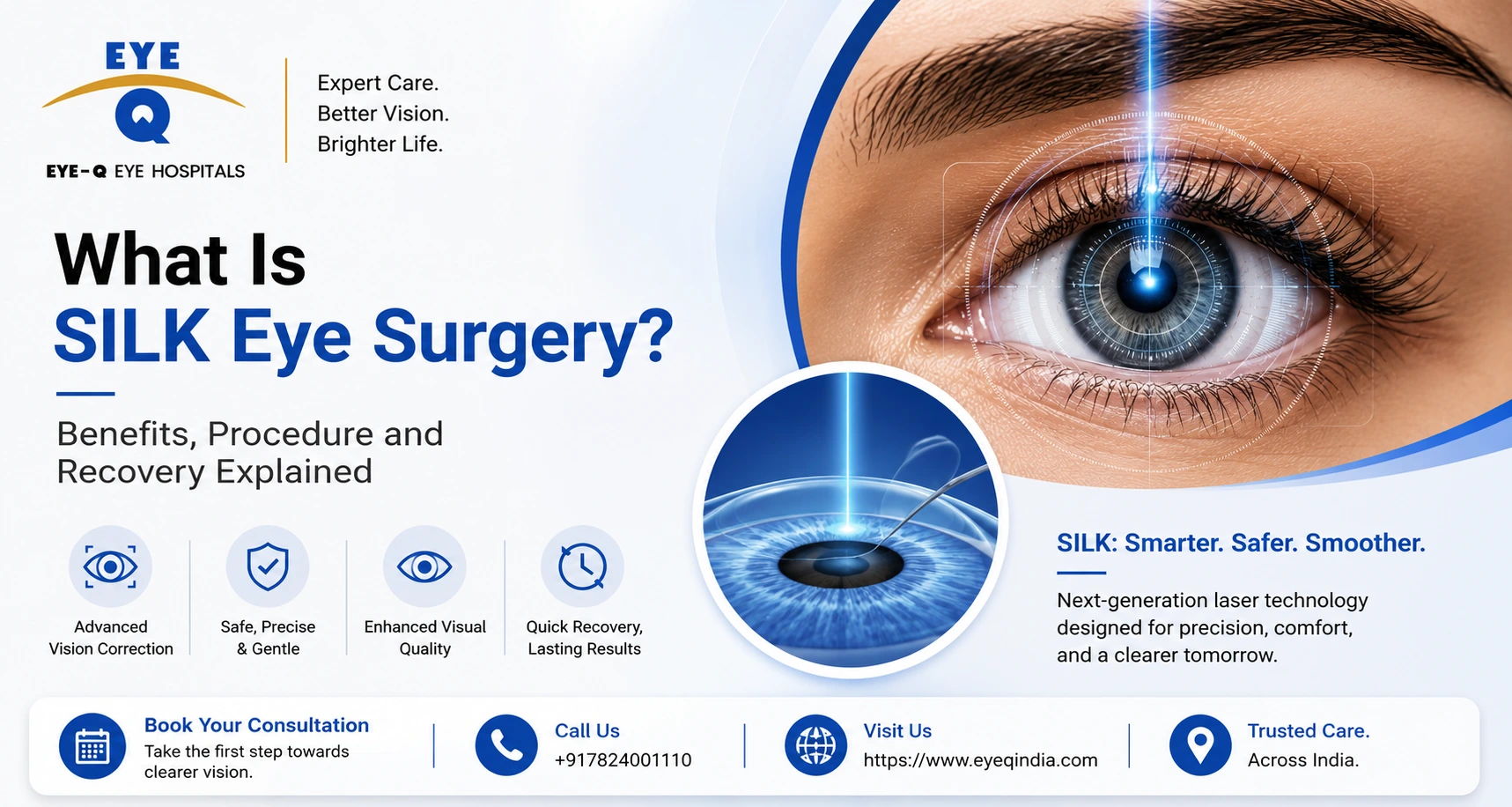
In simple terms: a high powered femtosecond laser carves a precisely shaped disc of corneal tissue (called a lenticule) inside your cornea without touching the surface. The lenticule is then removed through a tiny keyhole incision smaller than 2 mm. Removing it changes the curvature of the cornea, correcting the way light focuses on the retina – and giving you clear, unaided vision.
SILK corrects myopia (nearsightedness) up to -12.00 diopters and astigmatism up to -6.00 diopters. It is not currently indicated for hyperopia (farsightedness).
What Makes SILK Different from SMILE?
The word ‘smooth’ in SILK is not just branding. It refers to the biconvex lenticule design unique to SILK, which creates a smoother extraction path than SMILE’s plano-convex design, preserving more corneal nerves and reducing post operative dryness.
Also Read : Experience the SILK Procedure: Next-Gen Vision Correction
How Does SILK Eye Surgery Work? The Science Behind It
The Cornea and Refractive Errors
The cornea acts as your eye’s primary focusing lens. In myopia, the cornea is too curved, bending light to a focal point in front of the retina instead of directly on it producing blurry distance vision. In astigmatism, the cornea is unevenly curved like a rugby ball rather than a sphere, distorting vision at all distances.
SILK corrects these errors by removing a precisely calculated volume of corneal tissue, reshaping the cornea so it focuses light accurately onto the retina. No tissue is destroyed; it is simply extracted in one neat disc.
The ELITA Femtosecond Laser
The ELITA platform operates at an ultra-low energy level of approximately 40 nanojoules the lowest of any refractive laser currently in use. It fires up to 10 million laser spots per second with real-time sub-micron precision monitoring. If your eye moves even slightly, the system compensates automatically, ensuring the lenticule is cut exactly as planned. This ultra-low energy profile minimizes thermal damage to surrounding tissue, reducing inflammation and accelerating recovery.
The Biconvex Lenticule Advantage
SMILE uses a plano-convex lenticule (flat on top, curved below). SILK uses a biconvex lenticule (curved on both sides). This design creates a smoother tissue plane, reduces stress on the corneal nerve fibers during extraction, and preserves up to 30% more corneal biomechanical strength compared to LASIK Eye Surgery. The result is a stronger, more stable cornea post-surgery and a significantly lower incidence of dry eyes.
SILK Eye Surgery Benefits: Why Patients and Surgeons Choose It
1. Truly Flapless and Bladeless
LASIK requires a corneal flap (typically 8-10 mm) to be created and lifted. That flap never fully re-adheres. It can theoretically be displaced by trauma, rubbing, or direct impact, even years later a major concern for athletes and military personnel. SILK makes no flap. The micro-incision heals fully within weeks, restoring corneal structural integrity.
2. Lowest Dry Eye Risk of Any Laser Procedure
Creating a LASIK flap severs the sub basal corneal nerve plexus the network of nerves responsible for triggering normal tear production. Up to 40% of LASIK patients report significant dry eye in the first 3 months. SILK’s micro-incision disrupts far fewer corneal nerves. Clinical data shows 89% of SILK patients experience minimal discomfort during and after the procedure, and dry eye symptoms, when they occur, typically resolve within one to two weeks.
3. Faster, More Comfortable Recovery
With no flap healing to manage and minimal epithelial disruption, the SILK recovery is inherently faster. 98% of patients report improved vision within hours to two days post-surgery. Most can return to desk work and light activities within 24 hours.
4. Superior Corneal Biomechanical Preservation
Corneal strength matters long-term. A structurally weaker cornea is more susceptible to induced ectasia (progressive thinning), particularly if the prescription is high. SILK’s keyhole incision removes tissue from inside the stroma rather than the surface, preserving the stronger anterior stromal fibers. This makes SILK particularly suitable for individuals with moderately thin corneas who might not qualify for LASIK.
5. High-Definition, Customized Vision
The ELITA platform’s real-time sub-micron tracking delivers a level of precision that translates to better contrast sensitivity and reduced higher-order aberrations (halos, glare, starburst effects) compared to older platforms. 86% of patients achieved 20/20 vision one week after SILK in the 2023 clinical trial; 96% reached 20/20 by six months.
6. Suitable for Active Lifestyles
With no flap and a fully sealed micro-incision that heals within weeks, SILK is the preferred choice for athletes, swimmers, contact sports participants, defense personnel, and anyone with an active lifestyle where a post LASIK flap injury however rare is an unacceptable risk.
Also Read : Ditch the Specs, Seize Freedom: Introducing SILK at Eye-Q Hospitals!
What Is the Success Rate of SILK Eye Surgery?
The 2023 pivotal clinical trial of SILK (the study that supported CE certification) reported:
- 86% of patients achieved 20/20 (6/6) vision or better at 1 week post-surgery
- 96% of patients achieved 20/20 vision or better at 6 months post-surgery
- Zero major adverse events in the entire trial cohort
- No patient lost a line of best-corrected visual acuity
Independent real world data from early adoption centers in India and Europe is consistent with trial results. Over 98% of patients in broader registry data achieve 20/25 vision or better. The success of SILK surgery depends significantly on proper pre-operative screening and patient selection which is why choosing an experienced, well-equipped refractive surgery center matters enormously.
SILK Eye Surgery Side Effects: What to Expect Honestly
No surgical procedure is entirely without side effects. Here is an honest breakdown of what patients commonly experience and what is genuinely rare.
Common, Expected, and Temporary
- Mild watering, grittiness, or foreign-body sensation – first few hours
- Blurred or hazy vision – resolves within 24 to 48 hours for most patients
- Light sensitivity – improves over the first week
- Mild dryness – usually resolves within 1 to 2 weeks; managed with lubricating drops
- Mild halos or glare around lights at night – typically resolves within 1 to 4 weeks as the cornea heals
Less Common
- Fluctuating vision during the first 2 to 4 weeks as the cornea stabilizes
- Mild under correction or overcorrection – may require a follow-up enhancement procedure in a small percentage of cases
- Prolonged dry eye beyond 4 weeks – rare with SILK compared to LASIK
Rare
- Infection – extremely rare with correct antibiotic prophylaxis; estimated less than 0.01%
- Corneal ectasia – extremely rare; risk further minimized by rigorous pre-operative corneal screening
SILK Eye Surgery Recovery Time: A Day-by-Day Guide
Recovery after SILK is one of its most talked-about advantages. Here is what to realistically expect at each stage.
| Stage | What You Will Experience | What You Can Do |
|---|---|---|
| Day 0 (Day of Surgery) | Hazy, watery vision. Mild grittiness and light sensitivity for a few hours. Rest advised. | Go home and rest. Avoid screens and driving. |
| Day 1 | Significant vision improvement. Follow-up check with your surgeon. | Light desk work. Short screen sessions with breaks. |
| Days 2–3 | Vision stabilizing. Mild dryness possible. Use lubricating drops as instructed. | Most daily activities. Avoid rubbing eyes. |
| Week 1 | 86% of patients achieve 20/20. Continue prescribed antibiotic and anti-inflammatory drops. | Light exercise (walking, yoga). Avoid swimming or contact sports. |
| Weeks 2–4 | Vision continues to refine. Halos/glare (if any) subsiding. | Most sports. Continue avoiding water-contact activities. |
| Month 1–3 | Vision is largely stable. Final check-up at 3 months recommended. | Full unrestricted activity. Competitive sport cleared. |
| 6 Months | 96% of patients achieve 20/20. Final outcome established. | No restrictions. |
Post-SILK Care Checklist
- Use prescribed antibiotic and anti-inflammatory drops exactly as directed
- Use lubricating drops (preservative-free preferred) as often as needed for comfort
- Wear UV-protective sunglasses outdoors for at least one month
- Do not rub your eyes for at least 4 weeks
- Avoid swimming pools, lakes, or the sea for at least 4 weeks
- Avoid dusty or smoky environments during the first week
- Keep all scheduled follow-up appointments at 1 day, 1 week, 1 month, and 3 months
Also Read : Clear Vision for Content Creators: LASIK or SILK
Am I Eligible for SILK Eye Surgery?
SILK is not right for everyone. Standard eligibility criteria include:
You Are Likely Eligible If:
- You are aged 18 years or older with a stable prescription for at least 6 months
- Your myopia is within -12.00 diopters, with or without astigmatism up to -6.00 diopters
- Your corneal thickness is sufficient (determined by pre-operative pachymetry)
- Your tear film and overall eye health are satisfactory
- You do not have active keratoconus or corneal ectasia
SILK May Not Be Suitable If:
- You have farsightedness (hyperopia) – LASIK or ICL may be more appropriate
- You have glaucoma, severe dry eye syndrome, or a history of previous corneal surgery
- You are pregnant or breastfeeding (hormonal changes affect corneal stability)
- Your prescription is still changing year on year
The only way to know for certain is a comprehensive pre-operative evaluation. At EyeQ, our team uses advanced corneal topography, Penta am imaging, and aerometry to determine the safest and most effective procedure for your specific eyes. Book your FREE consultation today.
SILK vs LASIK vs SMILE: Side-by-Side Comparison
All three are highly effective procedures. Choosing between them depends on your prescription range, corneal anatomy, lifestyle, and priorities.
| Feature | SILK | SMILE | LASIK |
|---|---|---|---|
| Procedure type | Flapless, lenticule extraction | Flapless, lenticule extraction | Flap-based, excimer laser |
| Laser platform | ELITA femtosecond (2nd gen) | VisuMax femtosecond | Femto + excimer |
| Incision size | <2 mm | 2–4 mm | 8–10 mm flap |
| Dry eye risk | Lowest | Low | Highest |
| Vision at 1 week | 86% achieve 20/20 | ~80% achieve 20/20 | ~85% achieve 20/20 |
| Vision at 6 months | 96% achieve 20/20 | ~94% achieve 20/20 | ~90% achieve 20/20 |
| Corrects myopia | Yes (up to -12D) | Yes (up to -10D) | Yes (up to -12D) |
| Corrects hyperopia | No | No | Yes |
| Corrects astigmatism | Yes (up to -6D) | Yes (up to -6D) | Yes |
| Recovery to daily activity | 24 hours | 1–2 days | 24–48 hours |
| Thin cornea suitability | Good | Good | Limited |
| Active lifestyle suitability | Excellent (no flap) | Excellent (no flap) | Moderate |
| Long-term safety data | 2–3 years (growing) | ~10 years | 25+ years |
| Approx. cost per eye (India) | Rs. 65,000–1,10,000 | Rs. 55,000–90,000 | Rs. 25,000–60,000 |
Also Read : LASIK vs SILK vs SMILE Eye Surgery: 2026 Comparison
Which Procedure Is Right for You? Discuss With Your Surgeon
Neither SILK nor SMILE can treat farsightedness (hyperopia). If you are hyperopic and want laser correction, LASIK or ICL (Implantable Col lamer Lens) are the appropriate options. Always discuss your full prescription profile with your surgeon.
What Is the Cost of SILK Eye Surgery in India?
SILK eye surgery costs approximately Rs. 65,000 to Rs. 1,10,000 per eye in India (2026), depending on the city, hospital infrastructure, surgeon experience, and the specific ELITA laser platform configuration. Total cost for both eyes typically falls in the range of Rs. 1,30,000 to Rs. 2,20,000.
For context:
- Standard LASIK in India starts from approximately Rs. 25,000 per eye
- SMILE starts from approximately Rs. 55,000 per eye
- SILK starts from approximately Rs. 65,000 per eye
While SILK carries a higher upfront cost than standard LASIK, it is worth considering the long-term economics: annual expenditure on glasses and contact lenses (typically Rs. 10,000-30,000 per year) compounds significantly over a lifetime. SILK results can last 15 to 20 years or longer.
Many EyeQ centers offer easy EMI options with no-cost financing. Ask about payment plans during your consultation. Health insurance in India generally does not cover elective refractive surgery.
How Long Do SILK Eye Surgery Results Last?
SILK’s corneal reshaping is permanent. The lenticule, once removed, does not regenerate. Most patients enjoy clear, glasses-free vision for 15 to 20 years or more following SILK surgery.
Two natural factors can affect long-term outcomes:
- Presbyopia (age-related near vision loss): typically begins after age 40 and affects near reading vision regardless of any previous refractive surgery
- Myopic progression: patients who develop progressive myopia after surgery (more common in younger patients) may see some return of distance blur. This is why a stable prescription for at least 6 months before surgery is required.
Frequently Asked Questions
What is SILK in surgery?
SILK stands for Smooth Incision Lenticule Keratomileusis. It is a bladeless, flapless laser vision correction procedure that uses a second-generation femtosecond laser (the ELITA platform) to remove a precisely shaped disc of corneal tissue (lenticule) through a micro-incision of less than 2 mm, correcting myopia and astigmatism with minimal disruption to the corneal structure.
What is the cost of SILK surgery in India?
SILK eye surgery costs approximately Rs. 65,000 to Rs. 1,10,000 per eye in India (2026), varying by city, hospital, and surgeon experience. Both eyes together typically cost Rs. 1,30,000 to Rs. 2,20,000. Many centres offer EMI financing options.
What is the success rate of SILK eye surgery?
The 2023 clinical trial reported 86% of patients achieving 20/20 vision at 1 week and 96% achieving 20/20 at 6 months, with zero major adverse events. Broader real-world registry data shows over 98% of patients achieving 20/25 vision or better. Success depends heavily on correct pre-operative screening and patient selection.
What are the benefits of SILK eye surgery?
Key benefits include: flapless design eliminating flap-related complications; lowest dry-eye risk of any laser procedure; recovery to daily activities within 24 hours; superior corneal biomechanical preservation (up to 30% stronger than post-LASIK corneas); suitability for moderately thin corneas; and excellent outcomes for active lifestyles and contact sports participants.
Why is my vision blurry after SILK surgery?
Mild blurring in the first 24 to 48 hours is completely normal. It results from minor corneal surface changes and residual dryness as the eye heals. Vision typically clears significantly by Day 1. Persistent or worsening blurring beyond 3 to 5 days should prompt a call to your surgeon, though this is uncommon with SILK.
Is SILK better than LASIK?
For patients with myopia and astigmatism, SILK offers advantages over LASIK in terms of dry-eye risk, corneal strength preservation, and suitability for active lifestyles. However, LASIK can correct hyperopia (farsightedness) which SILK cannot, has 25+ years of long-term safety data (SILK has 2-3 years), and costs less. The best procedure depends on your individual prescription, corneal anatomy, and lifestyle priorities.