


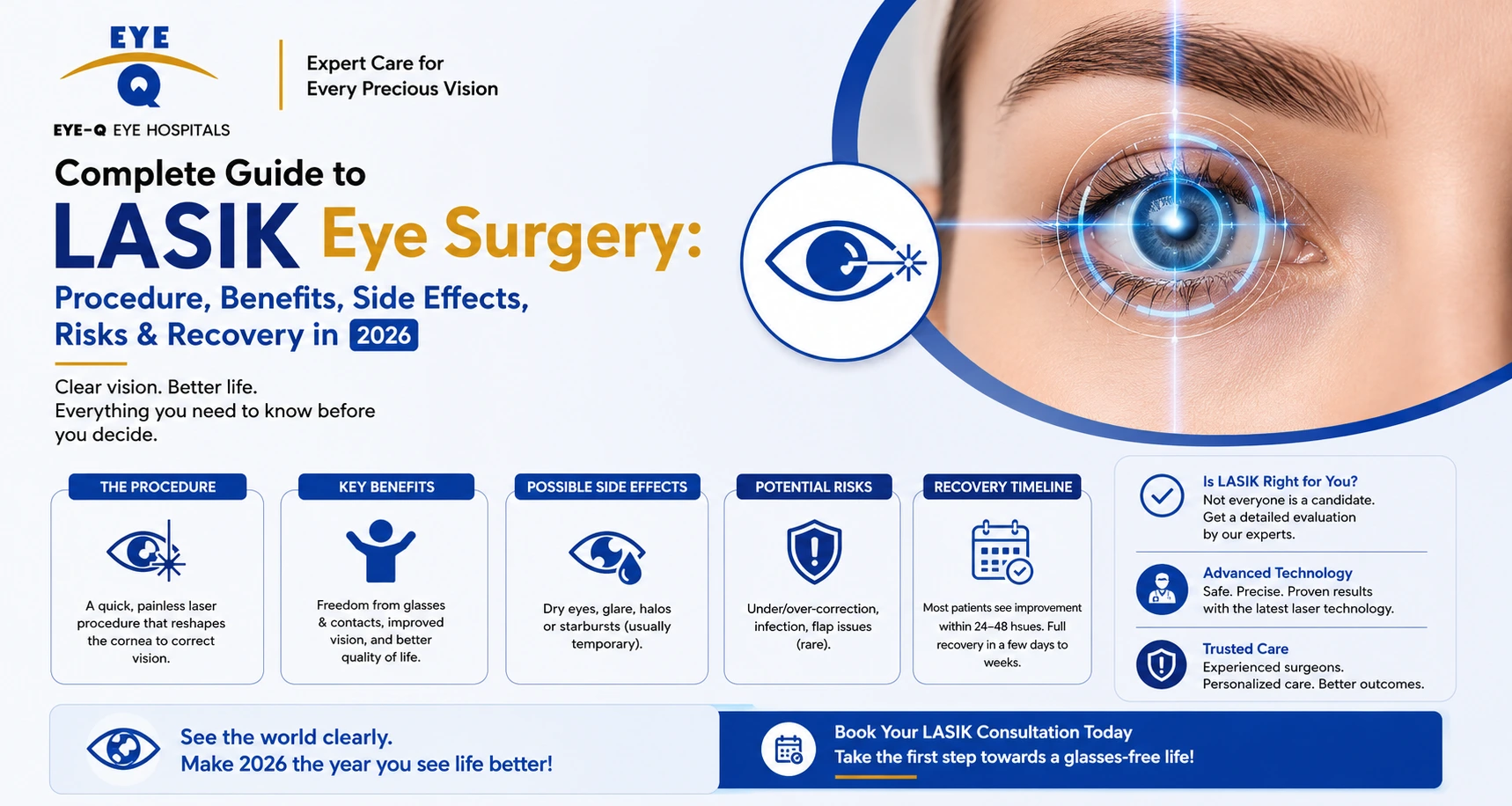
QUICK SUMMARY
LASIK (Laser-Assisted In Situ Keratomileusis) is the world’s most performed laser refractive surgery. It permanently reshapes the cornea to correct nearsightedness (myopia), farsightedness (hyperopia), and astigmatism.
Key facts: Takes 15-30 minutes. 96% patient satisfaction. Over 80% of patients no longer need glasses. Serious complications in less than 1% of cases. Recovery: most patients see clearly within 24-48 hours, full stabilization in 3-6 months. LASIK is not reversible – pre-operative screening is essential.
What Is LASIK Eye Surgery?
LASIK (Laser-Assisted In Situ Keratomileusis) is the world’s most widely performed refractive eye surgery, with over 40 million procedures performed globally. It uses a laser to permanently reshape the cornea – the clear front surface of the eye – so that light focuses correctly on the retina, eliminating or significantly reducing the need for glasses or contact lenses.
What it corrects: LASIK treats nearsightedness (myopia), farsightedness (hyperopia), and astigmatism. It is the only laser eye surgery among the three main options (LASIK, SMILE, SILK) that currently treats hyperopia.
How permanent is it? The corneal reshaping is permanent. However, natural age-related changes – particularly presbyopia (near vision loss in the 40s) – will still occur. About 35% of patients require an enhancement procedure within 10 years due to prescription drift, not reversal of the original surgery.
Learn more about LASIK Eye Surgery at EyeQ India and our refractive surgery options.
How Does LASIK Eye Surgery Work? Step by Step
LASIK works by permanently changing the curvature of the cornea. Here is exactly what happens during and around the procedure:
| Step | Timing | What Happens |
| Pre-operative Evaluation | 1-2 weeks before | Corneal mapping, axial length measurement, wavefront analysis, tear film assessment, dry eye check, pupil size measurement. Contact lens wearers must stop 1-3 weeks before. |
| Day of Surgery Preparation | Day of surgery | Arrive without eye makeup, perfumes, or lotions. No driving required to surgery. Numbing (anaesthetic) drops are instilled. A mild oral sedative may be offered. |
| Corneal Flap Creation | ~30 seconds per eye | A femtosecond laser creates a precise, thin hinged flap (~100-120 microns) on the cornea surface. You will feel brief pressure – not pain. |
| Corneal Reshaping | ~30-60 seconds per eye | The flap is gently lifted. An excimer laser reshapes the corneal stroma with ultra-precise pulses. You focus on a fixation light. A faint burning smell is normal. |
| Flap Repositioning | ~30 seconds | The flap is repositioned and adheres naturally without stitches. No sutures are needed. |
| Immediate Post-Op | 0-4 hours | Vision is blurry and eyes may water. Rest at home. Do not rub eyes. Begin prescribed antibiotic and anti-inflammatory drops. |
| Next Day Follow-Up | Day 1 | Vision check and slit-lamp examination to confirm flap position and healing. Most patients already see 20/20 or close to it. |
Also Read : Worried About LASIK Safety? Let’s Talk
Golden rule: If you are borderline on any criterion – thin corneas, moderate dry eye, or high prescription – a specialist can advise whether LASIK, SMILE, SILK, or ICL is the better fit for your eyes.
Check your LASIK eligibility at EyeQ India – Book a Pre-Operative Consultation
Benefits of LASIK Eye Surgery
LASIK has one of the highest satisfaction rates of any elective medical procedure worldwide. Key benefits include:
96% patient satisfaction: Consistently reported across large-scale clinical trials worldwide.
- Over 80% of patients no longer ne
- ed glasses or contact lenses for most daily activities after surgery.
- Rapid vision improvement: Most patients see clearly within 24-48 hours. Return to work typically within 2 days.
- Permanent corneal change: The corneal reshaping is lifelong; age-related changes (presbyopia, cataracts) will still occur naturally.
- Long-term cost saving: Eliminates or significantly reduces years of spending on glasses, contact lenses, and solutions.
- Wide prescription range: Corrects myopia up to -12 D, hyperopia up to +6 D, and astigmatism up to -6 D – the broadest range among laser options.
- Active lifestyle freedom: No more foggy lenses while running, swimming, or playing sports (once fully healed).
- Short procedure: 15-30 minutes total for both eyes, performed as a day procedure – no hospital admission needed.
Considering LASIK? Book a free LASIK eligibility check at EyeQ India
LASIK Eye Surgery Side Effects: Complete Guide
Most LASIK side effects are temporary and part of the normal healing process. Serious complications occur in fewer than 1% of patients. The table below covers every known side effect, its frequency, and what to do:
| Side Effect | Frequency | What Happens | Management |
| Dry eyes | Very Common | Affects ~95% initially; peaks at 3 months; usually resolves in 6-12 months | Use prescribed lubricating drops; avoid AC/fans; stay hydrated |
| Halos and glare around lights | Common (~20%) | More noticeable at night. Usually improves within 3-6 months | Wear sunglasses; avoid night driving in first weeks |
| Temporary blurred vision | Common | Vision fluctuates while cornea heals. Usually clears in days-weeks | Normal healing; rest and avoid screens for 24-48 hrs |
| Light sensitivity | Common | Eyes are extra sensitive to bright light for 1-2 weeks | Wear UV-blocking sunglasses outdoors |
| Mild burning or itching | Common | First 24-48 hours; numbing drops wear off | Use prescribed drops; do NOT rub eyes |
| Undercorrection / overcorrection | ~5% of cases | Vision not fully corrected; enhancement surgery may be needed | Enhancement can be done after vision stabilises (usually after 3-6 months) |
| Corneal flap complications (folds, displacement) | 0.16-15% | Flap can wrinkle or shift if eye is rubbed or hit | Never rub eyes post-LASIK; wear shield while sleeping for 1 week |
| Corneal ectasia (cornea bulging) | 0.033-0.6% | Cornea weakens and bulges; progressive vision loss. Serious but rare | Thorough pre-op screening prevents this; treated with corneal cross-linking |
| Regression (vision drifting back) | ~1% per year | Vision gradually returns toward original prescription over years | Enhancement surgery available; more common in high prescriptions |
| Permanent vision loss | Less than 0.3% | Extremely rare; associated with severe unmanaged complications | Prompt follow-up and proper post-op care minimises risk |
Seek immediate medical attention if you notice: sudden severe eye pain, rapid vision loss, flap displacement (feeling like something is in the eye), or signs of infection (excessive redness, discharge, swelling).
If you experience any post-LASIK concern, contact EyeQ India’s eye care team immediately – available across Gujarat, Haryana, UP and Uttarakhand.
What Are the Risks of LASIK Eye Surgery?
LASIK is FDA-approved and has an excellent safety record, but as with any surgical procedure, risks exist. Understanding them helps you make an informed decision:
Common Risks (Temporary – Resolve in Weeks to Months)
- Dry eye syndrome: The most common risk. LASIK severs corneal nerves during flap creation, temporarily reducing tear production. Affects up to 95% of patients initially. Resolves in 6-12 months for most. Women (especially pre-menopausal), those with diabetes, or high prescriptions face higher risk.
- Halos and glare: 20% of patients notice halos, starbursts, or glare around lights, particularly while driving at night. Usually temporary; improves as the cornea heals.
- Under correction / overcorrection: If the laser removes too little or too much tissue. Under correction is more common in high myopia. Enhancement surgery can correct this after the prescription stabilizes.
Less Common Risks
- Flap complications: Reported in 0.16%-15% of cases depending on measurement criteria. The corneal flap can wrinkle (microstriae), partially displace, or develop epithelial ingrowth. Most are correctable if caught early. Never rub your eyes post-LASIK.
- Regression: Vision gradually drifts back toward the original prescription. Occurs in approximately 1% of patients per year. More common in high prescriptions (above -6D). Enhancement surgery available if cornea is thick enough.
- Infection: Very rare (less than 0.1%). Prevented by antibiotic drops and strict post-operative hygiene.
Rare but Serious Risks
- Corneal ectasia (0.033%-0.6%): The cornea weakens and bulges outward progressively after surgery. This is the most serious rare complication. Prevention relies on rigorous pre-operative screening – topography, pachymetry, and wavefront analysis detect thin or irregular corneas. Treated with corneal cross-linking (CXL); severe cases may require corneal transplant.
- Permanent loss of best-corrected visual acuity (0.3%-4.8%): Extremely rare and usually associated with unmanaged severe complications. With proper screening and follow-up, this risk is minimal.
The risk of NOT having LASIK should also be considered: Contact lens wear carries its own risks including microbial keratitis (corneal infection), which affects approximately 1 in 500 contact lens wearers annually – comparable to LASIK complication rates.
Also Read : A Complete 2026 Comparison of LASIK, SILK and SMILE – Technology, Recovery, Cost & Who Should Choose What
Who Should NOT Get LASIK? Absolute Contraindications
Your ophthalmologist will rule LASIK out if any of the following apply. These are not preferences – they are clinical safety criteria:
- Keratoconus or corneal ectasia: The cornea is already thinning and bulging. LASIK would worsen this. See Refractive Services at EyeQ India for alternative options.
- Unstable prescription: Vision must be stable for at least 1-2 years. Operating on a changing prescription wastes the procedure.
- Severe dry eye disease: LASIK significantly worsens pre-existing severe dry eye. Consider SMILE or SILK instead.
- Thin corneas: Insufficient corneal tissue means the laser has no safe operating room. PRK, SMILE, or ICL may be alternatives.
- Severe myopia (beyond -12D): ICL is often the better option for very high prescriptions.
- Pregnancy or breastfeeding: Hormonal changes alter the prescription. Defer until 3 months after breastfeeding ends.
- Age under 18: Eyes are still growing. Surgery is not recommended before the prescription has been stable in an adult.
Not sure if you qualify? Book a comprehensive pre-operative LASIK evaluation at EyeQ India
LASIK Eye Surgery Recovery Time: What to Expect Day by Day
Recovery after LASIK is generally quick, but varies by individual. Here is a realistic timeline:
| Timeframe | What to Expect | Key Actions |
| Hours 1-4 | Blurry vision, watery eyes, mild burning sensation | Complete rest at home. Do not rub eyes. Begin eye drops. |
| Day 1 (24 hours) | Most patients see 20/20 or better. Minor fluctuations normal. | Follow-up appointment. No driving until cleared. |
| Days 2-7 | Vision stabilising fast. Halos/glare around lights at night common. | Return to office work. Avoid eye makeup, pools, rubbing. |
| Week 2-4 | Minor dry eye and light sensitivity may persist. | Resume light exercise. Continue lubricating drops. |
| Month 1-3 | Dry eye peaks at 3 months then improves. Vision largely stable. | Resume contact sports. Swimming cleared at 2 months. |
| Month 3-6 | Near-complete stabilisation for most patients. | Final vision check. Glasses/contact lens prescription if needed. |
| Year 1-2 | Full long-term stability established for majority. | Annual eye exams recommended going forward. |
| Years 5-10 | 86.1% maintain 20/40+ vision. 52% maintain 20/20 at 10 years. | 35% may need enhancement procedure over 10 years. |
Post-LASIK Do’s and Don’ts
- DO: Use all prescribed eye drops exactly as directed (antibiotic, anti-inflammatory, lubricating drops)
- DO: Wear protective goggles/shield while sleeping for the first 1 week
- DO: Wear UV-blocking sunglasses outdoors for at least 1 month
- DO: Follow the 20-20-20 rule when using screens: every 20 minutes, look 20 feet away for 20 seconds
- DO NOT: Rub your eyes under any circumstances for at least 3 months – this can displace the flap
- DO NOT: Swim or use hot tubs for at least 4-6 weeks (infection risk)
- DO NOT: Use eye makeup for at least 2 weeks post-surgery
- DO NOT: Play contact sports (boxing, martial arts, football) for at least 4 weeks
Post-operative care guidance and follow-up appointments available at EyeQ India hospitals near you.
LASIK vs SMILE vs SILK vs PRK vs ICL: Which Is Right for You?
Multiple laser and non-laser vision correction options exist. Here is how LASIK compares to all alternatives:
| Procedure | Technique | Treats | Recovery | Dry Eye Risk | Availability India | Key Note |
| LASIK | Flap + excimer laser | Up to -12D myopia; hyperopia; astigmatism | Few days | Moderate (flap severs nerves) | Widely available in India | 25+ years proven data; treats hyperopia |
| SMILE | Flapless lenticule extraction | Myopia up to -10D; astigmatism to -3D | 2-3 days | Low | Available – select centres | Lower dry eye; no flap risk |
| SILK | Flapless; biconvex lenticule | Myopia up to -12D; astigmatism to -6D | 24 hours | Lowest | Growing – select centres | Newest technology; fastest recovery |
| PRK / Trans-PRK | Surface ablation; no flap | Myopia, hyperopia, astigmatism | 1-2 weeks | Low | Available | Best for thin corneas; longer recovery |
| ICL | Lens implant (no corneal removal) | Up to -20D myopia | Few days | None | Available | Reversible; ideal for high prescriptions |
LASIK remains the best option if: you have a standard prescription range, adequate corneal thickness, mild-to-moderate dry eye at most, and want the broadest-tested procedure including hyperopia correction.
Compare your options with an EyeQ India specialist: LASIK Surgery | Refractive Services
What Is the Best Age to Get LASIK?
The ideal age for LASIK is between 22 and 40 years. Here is why:
- Under 18: Not recommended. Eyes are still growing; prescription is likely unstable.
- 18-21: Possible but borderline. Requires at least 2 years of prescription stability. Many ophthalmologists prefer to wait until 22-25.
- 22-40 (Ideal range): Prescription is typically stable. Corneal tissue is healthy. No presbyopia yet. Best outcomes in this group.
- 40-50: Presbyopia (age-related near vision loss) will develop regardless of LASIK. Monovision LASIK can be considered. Discuss presbyopia options at consultation.
- Above 50: Cataracts may be developing. Refractive Lens Exchange (RLE) combined with a premium IOL may be more appropriate than LASIK.
Not sure if your age or prescription makes you a good candidate? Book a LASIK consultation at EyeQ India
LASIK Long-Term Results: What the Evidence Shows
Clinical studies following thousands of patients over decades provide clear evidence of LASIK’s long-term performance:
- 1 year: 6% of patients maintain 20/20 binocular vision. Only 1.4% need enhancement.
- 5 years: Results remain largely stable. Minor regression of approximately -0.74 diopters from 3 months to 12 years is the average drift.
- 10 years: 1% maintain 20/40 or better vision. 52% maintain 20/20. 76.3% remain within ±1.00 diopter of target.
- 20 years: Approximately 20% of patients will have sought enhancement procedures. Mostly due to age-related changes rather than LASIK failure.
Age matters: Patients under 40 experience more vision drift (-0.54 D over 18 years) than those over 40 (-0.05 D). Femtosecond LASIK performs better long-term than older blade-based flap techniques.
Key message: LASIK does not wear off or fail – it is the natural ageing of the eye that causes any long-term changes. Regular annual eye exams are the best protection against missing these changes.
Ready to find out if LASIK is right for your eyes? Book a comprehensive LASIK evaluation at EyeQ India – expert ophthalmologists, advanced laser technology, 30+ locations across India.
Related services at EyeQ India: LASIK Surgery | Refractive Services | Cataract Surgery | Glaucoma Treatment | General Eye Care
Frequently Asked Questions
What is the risk of LASIK eye surgery?
Common risks include dry eyes (up to 95% initially, usually temporary) and halos/glare (20%, resolves in 3-6 months). Serious complications such as corneal ectasia (0.033%-0.6%) or permanent vision loss (less than 0.3%) are rare with proper pre-operative screening.
Is LASIK eye surgery safe?
Yes – LASIK is FDA-approved with a 96% satisfaction rate across 40 million+ procedures. Serious complications occur in less than 1% of patients; safety depends heavily on thorough candidate screening before surgery.
How long is recovery after LASIK?
Most patients see clearly within 24-48 hours and return to work in 2 days. Full vision stabilisation takes 3-6 months; contact sports and swimming should be avoided for 4-6 weeks.
Is laser eye surgery (LASIK) painful?
No – numbing drops make the procedure virtually painless. Mild pressure during flap creation (about 30 seconds) is normal; mild burning or grittiness for a few hours post-op is managed with lubricating drops.
What is the best age to get LASIK?
The ideal age is 22-40 years, when the prescription is stable and corneal tissue is healthy. LASIK is not recommended under 18; patients over 40 should also discuss presbyopia management at the same consultation.
How long does LASIK eye surgery last?
The corneal reshaping is permanent. About 35% of patients need an enhancement procedure within 10 years due to natural age-related prescription drift, not because LASIK wears off.
Is LASIK eye surgery available near me in India?
LASIK is widely available across major and tier-2 Indian cities. EyeQ India offers LASIK across 30+ locations in Gujarat, Haryana, Uttar Pradesh, and Uttarakhand with certified ophthalmologists and modern laser technology.
What is the LASIK procedure and recovery time in brief?
LASIK takes 15-30 minutes for both eyes – a corneal flap is created, the cornea reshaped with a laser, and the flap replaced. Vision clears within 24-48 hours; full stabilization takes 3-6 months.
Medical Disclaimer
This article is for informational purposes only and does not constitute medical advice. LASIK suitability must be assessed by a qualified ophthalmologist through a proper pre-operative evaluation. Always consult a licensed eye specialist before making any surgical decision.