


QUICK SUMMARY
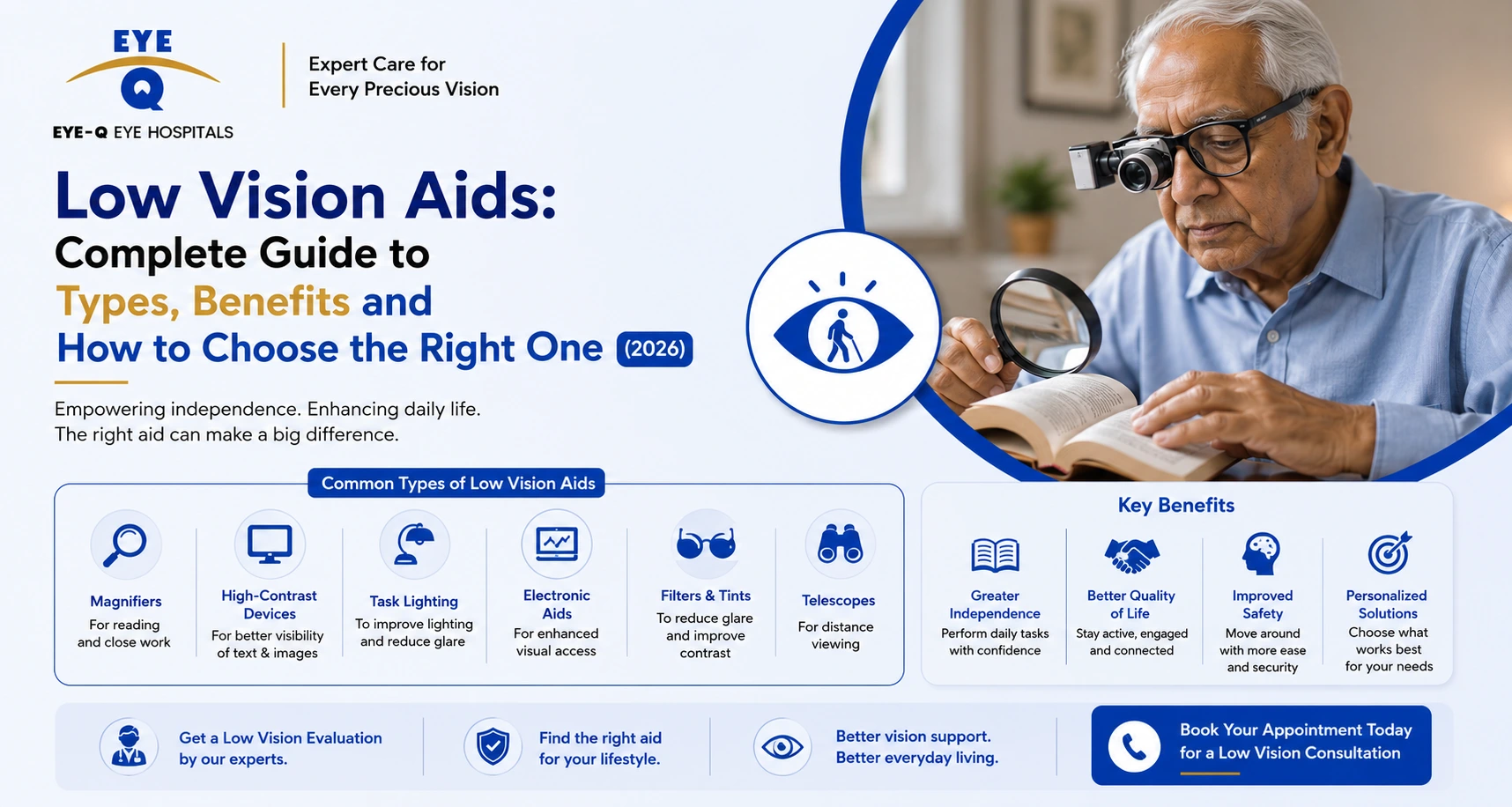
Low vision aids are tools and devices that help people with permanent vision loss make the most of the sight they still have. They cannot restore vision, but they help people read, write, move around, and live more independently.
Who needs them: People whose vision cannot be fully corrected by glasses, contact lenses, or surgery. Causes include macular degeneration, glaucoma, retinitis pigmentosa, diabetic eye disease, and inherited conditions.
Key insight: The right low vision aid is not the same for everyone. A low vision specialist assesses each person and recommends aids based on their specific type of vision loss, lifestyle, and daily tasks.
What Is Low Vision? Understanding the Basics
Think of low vision like a camera that is broken in a way that no repair shop can fix completely. The camera still works – it can still take some pictures but they are blurry, missing parts, or too dark, and no filter or lens change fully fixes it.
Low vision is defined as: significant visual impairment that cannot be fully corrected by glasses, contact lenses, medication, or surgery. The person still has some usable vision – they are not completely blind – but their sight is permanently reduced in a way that affects daily life.
Low vision can affect different parts of what you see:
- Central vision loss: The middle of your vision is blurry or has a dark patch. Reading, recognizing faces, and seeing fine detail becomes difficult. Most common in macular degeneration.
- Peripheral (side) vision loss: You can see straight ahead but the edges of your vision are missing. Like looking through a narrow tube. Common in glaucoma and retinitis pigmentosa.
- Night blindness: Difficulty seeing in low light or adjusting from bright to dark environments. An early sign of retinitis pigmentosa.
- General blur and reduced contrast: Everything looks faded, hazy, or lacks sharp edges. Can happen in multiple conditions.
Important: Low vision is not the same as legal blindness. Many people with low vision have enough sight to benefit greatly from the right low vision aids, especially if they start rehabilitation early.
Worried about your vision or a family member’s? Book a low vision assessment at EyeQ India
What Are Low Vision Aids? Simple Explanation
Low vision aids are tools, devices, and techniques that help people with permanent vision loss make the most of the sight they still have. They cannot cure or restore vision – but they help people read newspapers, recognise faces, cook meals, use smartphones, watch television, and move around safely.
The key word is ‘remaining vision’. Low vision aids work by making the most of the sight that is still there – making things bigger, brighter, higher contrast, or converting visual information into sound or touch.
Low vision rehabilitation is a specialist service. A trained low vision specialist does not just hand you a magnifying glass – they assess your specific vision loss, your daily tasks, your home and work environment, and then recommend a personalised combination of aids and techniques.
Types of Low Vision Aids: Complete Guide
There are many different types of low vision aids, each designed for different types of vision loss and different daily activities. Here is a complete overview:
| Type | What It Is | Best For | Advantages | Limitations |
| Optical Magnifiers | Handheld, stand, or spectacle-mounted lenses that enlarge text and objects. | Reading, close work, crafts | Portable, affordable, no batteries | Handheld versions need steady hands |
| Telescopic Glasses | Miniature telescopes in glasses frames for distance tasks. | TV, boards, signs, bioptic driving | Wearable, hands-free | Learning curve; reduced depth perception initially |
| Video Magnifiers (CCTV) | Camera + screen system showing magnified real-time images. Desktop or portable. | Reading, writing, any close task | High magnification, adjustable contrast | Desktop versions are bulky; higher cost |
| Portable Electronic Magnifiers | Handheld camera-and-screen device for on-the-go magnification. | Shopping, labels, outdoor tasks | Compact, battery-powered | Smaller screen than desktop CCTV |
| Screen Readers / Text-to-Speech | Software reading on-screen content aloud (JAWS, NVDA, VoiceOver, TalkBack). | Computer, phone, tablet | Works on most devices; free options available | Learning time required |
| Smartphone AI Apps | Built-in accessibility and AI apps: Seeing AI, Google Lookout, Zoom, VoiceOver. | Daily phone tasks, text reading, face recognition | Free, always with you | Needs basic tech familiarity |
| Talking Devices | Watches, clocks, glucose meters, thermometers, and scales that speak their reading. | Daily routines, health monitoring | No screen needed, easy to use | Task-specific only |
| Large Print Materials | Books, newspapers, keyboards, medication labels in enlarged font. | Reading, writing, identification | Immediate, no devices needed | Limited availability; heavy for large volumes |
| Adaptive Lighting | Task lamps, daylight-spectrum bulbs, contrast-enhancing setups. | All indoor activities | Inexpensive, improves contrast, reduces glare | Needs proper placement |
| White Cane and Mobility Aids | Long white cane for detecting obstacles. GPS apps for outdoor independence. | Walking, commuting, travel | Widely available, training-supported | Requires mobility training with specialist |
| Braille and Tactile Aids | Braille books, refreshable Braille displays, tactile maps and graphics. | Reading, navigation, education | Highly effective for severe vision loss | Requires time to learn Braille |
Key insight: Most people with low vision benefit from a combination of aids – not just one device. For example, a person with macular degeneration might use a video magnifier at home for reading, a monocular telescope for TV, and a smartphone AI app when out shopping.
Explore the full range of Low Vision Aids to Improve Daily Living and Independence for additional detail on optical options.
Who Qualifies for Low Vision Aids?
This is one of the most important questions – and one that no competitor article answers clearly. Here is the straight answer:
| Qualifying Criterion | What It Means |
| Best-corrected visual acuity (BCVA) of 6/18 or worse in the better eye | Even with the best possible glasses, vision is too poor for many daily tasks. This is the WHO threshold for moderate visual impairment. |
| Visual field loss affecting daily functioning | Significant tunnel vision, blind spots, or peripheral loss impacting navigation, safety, or driving. |
| Contrast sensitivity loss | Difficulty distinguishing between similar shades — for example, seeing a step edge or reading low-contrast print. |
| Vision loss that surgery or medical treatment cannot improve | The underlying damage (e.g., macular scarring, optic nerve loss) is permanent and stable. |
| Any age — children to elderly | Low vision occurs at any age due to genetic conditions, injury, or progressive eye disease. |
| Any condition causing significant, permanent vision loss | AMD, glaucoma, retinitis pigmentosa, diabetic retinopathy, albinism, cortical visual impairment, inherited dystrophies. |
What about people who think they ‘do not qualify’? Many people wait far too long before seeking low vision help – often years after their vision has deteriorated. There is no minimum level of vision loss required to seek a low vision assessment. If your vision is affecting your daily life, quality of life, or safety in any way, you qualify for an assessment.
Children too: Low vision rehabilitation is available and highly effective for children from infancy. Early intervention in childhood visual impairment prevents learning delays and promotes independence.
Not sure if you or your family member qualifies? Book a low vision evaluation at EyeQ India – specialist assessment, not just a standard eye test.
How to Stop Vision Loss: What Actually Works
Let us be honest: in most cases, low vision cannot be reversed. But vision loss can often be slowed, stabilized, or in some cases prevented from reaching the stage where low vision aids become necessary. Here is what the evidence shows:
- Treat underlying conditions promptly: Cataracts can be removed. Glaucoma can be controlled with drops or surgery. Diabetic retinopathy can be managed with laser or injection therapy. Addressing these conditions before they cause severe damage is the single most effective step.
- Regular eye exams: Many causes of vision loss are silent in early stages – glaucoma, macular degeneration, and diabetic retinopathy give no warning until significant damage has occurred. Annual eye exams detect these early.
- Anti-VEGF injections for wet AMD: Ranibizumab, bevacizumab, and aflibercept injections have transformed the outlook for wet macular degeneration – stabilising vision in over 90% of patients when given early.
- Nutritional supplements for dry AMD: AREDS2 formula (vitamins C, E, zinc, copper, lutein, zeaxanthin) has been shown to slow progression of intermediate to advanced dry AMD by about 25%.
- Lifestyle: Stopping smoking (dramatically reduces AMD and cataract risk), managing blood sugar (prevents diabetic retinopathy), wearing UV-protective sunglasses (reduces AMD and cataract risk), and regular exercise all help protect vision long-term.
When vision loss has already occurred: Low vision rehabilitation begins with a specialist assessment. The sooner rehabilitation starts after vision loss, the better the outcomes for daily independence.
For treatments that can prevent or slow vision loss, consult EyeQ India’s retina and glaucoma specialists
Best Low Vision Aids by Eye Condition
The best low vision aid is not the same for everyone – it depends entirely on your specific condition and how it affects your vision. Here is a condition-by-condition guide:
| Condition | Vision Affected | Best Low Vision Aids | Key Clinical Note |
| Macular Degeneration (AMD) | Central vision loss – reading, faces, detail blurred. Side vision usually intact. | Low vision glasses for macular degeneration (high-add spectacles), CCTV video magnifiers, eccentric viewing training (using peripheral retina). OrCam AI glasses also highly effective. | Eccentric viewing therapy trains the person to use the peripheral retina as a substitute central area. Often life-changing with 6-8 weeks of practice. |
| Glaucoma | Peripheral tunnel vision loss. Central vision often preserved until late. | Field expansion prisms, reverse telescopes for field awareness, high-contrast environments, orientation and mobility training, white cane for safety. | Field expansion prism systems optically shift more of the visual scene into the remaining central field. Especially useful for navigation and detecting obstacles. |
| Retinitis Pigmentosa (RP) | Night blindness first, then progressive tunnel vision from periphery inward. | Night vision monoculars, field expansion prisms, tinted lenses for light sensitivity (amber or plum tints), white cane. As RP progresses, aids are updated. | Argus II bionic eye (retinal implant) and gene therapy (Luxturna for RPE65 gene mutations) are now available in some specialist Indian centres – remarkable recent advances for specific RP types. |
| Diabetic Retinopathy | Patchy central or widespread vision loss. Vision can fluctuate. | Video magnifiers, screen readers, talking glucose monitors. Low vision aids should only be fitted when the diabetic eye condition is stable and treated. | Unstable vision from active diabetic disease makes prescription unreliable. Always stabilise the condition medically before low vision rehabilitation. |
| Glaucoma + Cataract (combined) | Both peripheral loss and general blur. | Cataract surgery first (if possible), then re-assess for low vision aids. Often cataract removal alone dramatically improves vision. | Always treat reversible conditions before prescribing low vision aids. A treatable cataract should be removed first. |
| Cortical Visual Impairment (CVI) | Brain cannot process vision signals correctly. Eyes may be structurally normal. | CVI-specific adaptations: high contrast materials, simple environments, slowed visual processing, specialist CVI educational support. | CVI is now the leading cause of low vision in children. Standard low vision aids are often not appropriate – specialist CVI rehabilitation is completely different. |
Low Vision Aids for Macular Degeneration
Macular degeneration (AMD) is the most common cause of low vision in India and worldwide in people over 60. Because AMD destroys central vision while leaving peripheral vision intact, the rehabilitation goal is to train the peripheral retina to substitute for the damaged macula – a skill called eccentric viewing.
The most effective aids for macular degeneration include: high-magnification spectacle aids (low vision glasses for macular degeneration), desktop CCTV video magnifiers for reading, OrCam AI smart glasses for real-world independence, and eccentric viewing training from a specialist.
Learn more about Low Vision Glasses and Aids for Macular Degeneration and the optical options available.
Low Vision Aids for Retinitis Pigmentosa
Retinitis pigmentosa (RP) is different from AMD – it destroys peripheral vision first and progresses slowly from the edges inward. Night blindness is usually the first symptom, often appearing in childhood or adolescence.
The challenges are different from AMD: RP patients need night vision aids, field expansion prisms to widen the remaining tunnel of central vision, and light-sensitivity filters (especially amber tints which block blue light and improve contrast in varying light conditions).
Recent advances for retinitis pigmentosa: Gene therapy with Luxturna (voretigene neparvovec) is now approved and available for RP caused by mutations in the RPE65 gene. The Argus II bionic retinal implant is another option for advanced RP. These represent genuinely exciting recent advances – the first treatments to address the underlying cause rather than just managing the symptoms.
Recent Advances in Low Vision Aids (2022-2026)
Low vision care has changed dramatically in the last few years. Several technologies that seemed like science fiction a decade ago are now real, available, and accessible. Here is what is new:
| Advance | What It Does | Status | Best For |
| OrCam MyEye / MyReader (AI Smart Glasses) | Camera on glasses frame reads text aloud, recognises faces, identifies products and money. Works in real time. | Available now | Any low vision condition. Especially useful for macular degeneration and severe central vision loss. |
| eSight Electronic Glasses | Head-mounted electronic glasses with high-speed camera and screens inside the lenses showing enhanced, magnified images. | Available now | Low vision from many causes. Not suitable for complete blindness. |
| Argus II Retinal Implant (Bionic Eye) | Surgically implanted electrode array on the retina. External camera sends signals to implant, creating basic visual perception. | Available in specialist centres | Advanced retinitis pigmentosa where some retinal cells remain. |
| Gene Therapy (Luxturna for RPE65 RP) | Single injection of corrective gene into retinal cells. Can restore usable vision in specific genetic RP types. | Approved USA/EU; select Indian centres | RP caused by mutations in the RPE65 gene (confirmed by genetic testing). |
| Seeing AI and Google Lookout Apps | Free AI-powered smartphone apps that describe scenes, read text, recognise faces, identify objects, and scan barcodes. | Free – available now on iOS and Android | Any low vision patient with a smartphone. Remarkable tool at zero cost. |
| Cortical Visual Prosthetics (Orion) | Electrode array implanted directly in the visual cortex (brain). Bypasses the eye entirely for patients with no functional eyes or optic nerves. | Early clinical trials | Blindness from optic nerve disease, eye loss, or conditions where retinal implants are unsuitable. |
| Stem Cell Therapy for AMD | Stem cells used to replace damaged retinal pigment epithelium (RPE) cells in age-related macular degeneration. | Advanced clinical trials | Dry AMD with significant central vision loss. Commercially available treatment is still 2-5 years away. |
What this means for patients in India: AI-powered apps like Seeing AI and Google Lookout are free and available right now on any modern smartphone. OrCam devices are available in India through specialist low vision centres. Gene therapy for specific genetic conditions is now accessible in a small number of Indian hospitals. The gap between what is possible and what is available in India is closing fast.
Ask about the latest low vision technology at EyeQ India – specialist assessment using current best-practice.
How to Choose the Right Low Vision Aid
Walking into a shop and buying a magnifying glass is not low vision rehabilitation. The right low vision aid depends on your specific vision loss, your daily tasks, your home environment, your work, and your personal preferences. Here is the step-by-step process:
- Step 1 – Low Vision Assessment: A specialist measures not just your visual acuity but also your contrast sensitivity, glare sensitivity, visual field, and the specific tasks that are most difficult for you.
- Step 2 – Trial of different aids: You try different devices in clinic to see which gives the best result for your specific tasks. What works for one person’s macular degeneration may not work for another’s glaucoma.
- Step 3 – Home assessment: A specialist may visit your home or workplace to assess lighting, layout, and practical needs. Low vision is not just about devices – it is about the whole environment.
- Step 4 – Training and practice: Most low vision aids require training to use effectively. Eccentric viewing for AMD, white cane techniques for RP, and learning screen readers all take time and specialist support.
- Step 5 – Review and update: Vision changes over time. What is right today may need adjusting in 12-24 months. Regular review appointments keep the rehabilitation plan current.
Access the full low vision rehabilitation pathway at EyeQ India – 30+ locations across India.
How to Maintain Your Low Vision Aids
Low vision aids are precision instruments. Taking care of them properly ensures they keep working well and last much longer. Here is what every user should know:
| Maintenance Step | How to Do It Right |
| Clean optical lenses regularly | Use a lens cleaning cloth and lens cleaning solution. Never use tissue paper or shirt fabric – they scratch optical surfaces. Clean handheld magnifiers daily if used frequently. |
| Check and replace batteries | Electronic magnifiers, portable devices, and talking devices run on rechargeable or replaceable batteries. Charge overnight; keep a spare battery pack when travelling. |
| Inspect for damage before use | Check for cracks, chips, or scratches on magnifier lenses. Even a small chip can distort the image significantly. Replace damaged lenses promptly. |
| Store properly when not in use | Keep optical aids in a case or pouch when not in use. Avoid leaving in direct sunlight (heat damages optics and electronics). Keep away from dust and moisture. |
| Update your prescription regularly | Vision changes over time. An aid that was correct 2 years ago may no longer give the best result. Plan a low vision review every 12-24 months or when you notice the aid is less helpful. |
| Update software and apps | Electronic aids, screen readers, and smartphone apps receive updates that improve performance, fix bugs, and add new features. Enable automatic updates or check manually monthly. |
| Report any sudden vision change immediately | If your vision changes suddenly or the aid is no longer helping as expected, see your eye specialist promptly. A sudden change may indicate a new eye problem needing urgent treatment. |
Low Vision Aid Glasses: What Are They?
Many people search for ‘low vision aids glasses’ – let us explain clearly what spectacle-based low vision aids are and how they differ from regular glasses. Regular glasses correct the focus of the eye (refractive error). Low vision spectacle aids work differently – they use much higher magnification, telescopic systems, or prism corrections to help a damaged eye make the most of its remaining ability.
- High-add reading spectacles (+4.00 to +20.00 D or more): Extremely strong reading lenses for people with central vision loss. Require very close reading distance (5-25 cm) but give excellent magnification.
- Bioptic telescopic spectacles: Small telescopes mounted on regular glasses frames. The person looks through the regular lens most of the time and dips their head briefly to look through the telescope for specific tasks (signs, TV, bioptic driving in some countries).
- Prism spectacles for field expansion: Prisms built into glasses redirect visual information from the blind area into the seeing area of the retina. Used in glaucoma and retinitis pigmentosa.
- Tinted and UV-filtering spectacles: Amber, plum, or grey tints that improve contrast and reduce light sensitivity. Particularly useful in retinitis pigmentosa and conditions causing photophobia.
Key fact: These are not off-the-shelf products. Low vision spectacle aids must be prescribed, fitted, and followed up by a trained low vision optometrist or ophthalmologist. The wrong aid can actually make things worse.
Key Takeaways
- Low vision aids help people make the most of their remaining sight – they cannot restore vision, but they restore independence.
- There are over 11 types of aids, from simple magnifiers to AI-powered smart glasses and bionic eye implants.
- The right aid depends on your specific condition – macular degeneration, glaucoma, and retinitis pigmentosa all need different approaches.
- Anyone whose vision affects daily life qualifies for a low vision assessment. Do not wait.
- Recent advances are remarkable: gene therapy, AI smart glasses, and retinal implants are now real and available in India.
- Maintain your aids: clean, charge, update, and review every 12-24 months.
Ready to find the right low vision aid for you or a family member? Book a specialist low vision assessment at EyeQ India – comprehensive rehabilitation, 30+ locations across India.
Related services at EyeQ India: General Eye Care | Retina Treatment | Glaucoma Treatment | Cataract Surgery
Frequently Asked Questions
What are the treatments for low vision aids?
Low vision rehabilitation is not a treatment for the underlying eye disease – it is a programme of aids, devices, and techniques that help people use their remaining vision better. Aids include optical magnifiers, video magnifiers, telescopic glasses, screen readers, talking devices, and adaptive lighting. The programme also includes training in how to use each aid effectively.
How to stop vision loss?
Treating underlying conditions early is the most effective approach: anti-VEGF injections for wet macular degeneration, pressure-lowering drops or surgery for glaucoma, laser or injection therapy for diabetic retinopathy. Annual eye exams are essential for early detection. AREDS2 supplements slow dry AMD progression. Stopping smoking, managing blood sugar, and wearing UV-protective sunglasses also help long-term.
What are the best low vision aids?
There is no single ‘best’ aid – the right choice depends on your condition and daily needs. For reading, CCTV video magnifiers and high-add spectacles are most effective. For independence and outdoor use, OrCam smart glasses or smartphone AI apps are transformative. For mobility, white cane training and GPS apps are essential. A low vision specialist recommends the right combination for each individual.
What are the types of low vision aids?
The main types are: optical magnifiers (handheld, stand, spectacle-mounted), telescopic glasses, video magnifiers (CCTV), portable electronic magnifiers, screen readers and text-to-speech software, smartphone AI apps, talking devices, large print materials, adaptive lighting, white canes and mobility aids, and Braille and tactile aids.
How do I maintain low vision aids?
Clean optical lenses daily with a proper lens cloth and solution. Check and charge batteries regularly. Store devices in their cases away from sunlight and dust. Update software and apps regularly. Plan a specialist review every 12-24 months as vision changes over time. Report any sudden vision change to your eye doctor immediately.
Who qualifies for low vision aids?
Anyone whose vision cannot be fully corrected by glasses, contact lenses, or surgery qualifies for a low vision assessment. The typical threshold is best-corrected visual acuity of 6/18 or worse, or significant visual field loss. However, any person whose vision affects daily life, safety, or independence can and should seek a specialist assessment – there is no minimum level of vision loss required.
Are there low vision aids for retinitis pigmentosa?
Yes. For retinitis pigmentosa, specialist aids include night vision monoculars, field expansion prisms, amber tinted lenses for light sensitivity, and white cane training. Gene therapy (Luxturna) is now available in India for specific RPE65-related RP. The Argus II retinal implant is another option for advanced RP. A specialist low vision assessment tailors the right combination to your current stage of the condition.
What are the recent advances in low vision aids?
AI-powered smart glasses (OrCam MyEye) that read text and recognise faces, free smartphone AI apps (Seeing AI, Google Lookout), retinal implants (Argus II), gene therapy for specific genetic retinal conditions (Luxturna), and stem cell therapy trials for macular degeneration are among the most significant recent advances. Several of these are now available in India.
Medical Disclaimer
This article is for informational purposes only. Low vision rehabilitation requires assessment by a qualified specialist. Always consult a licensed ophthalmologist or low vision optometrist for personalized advice.