



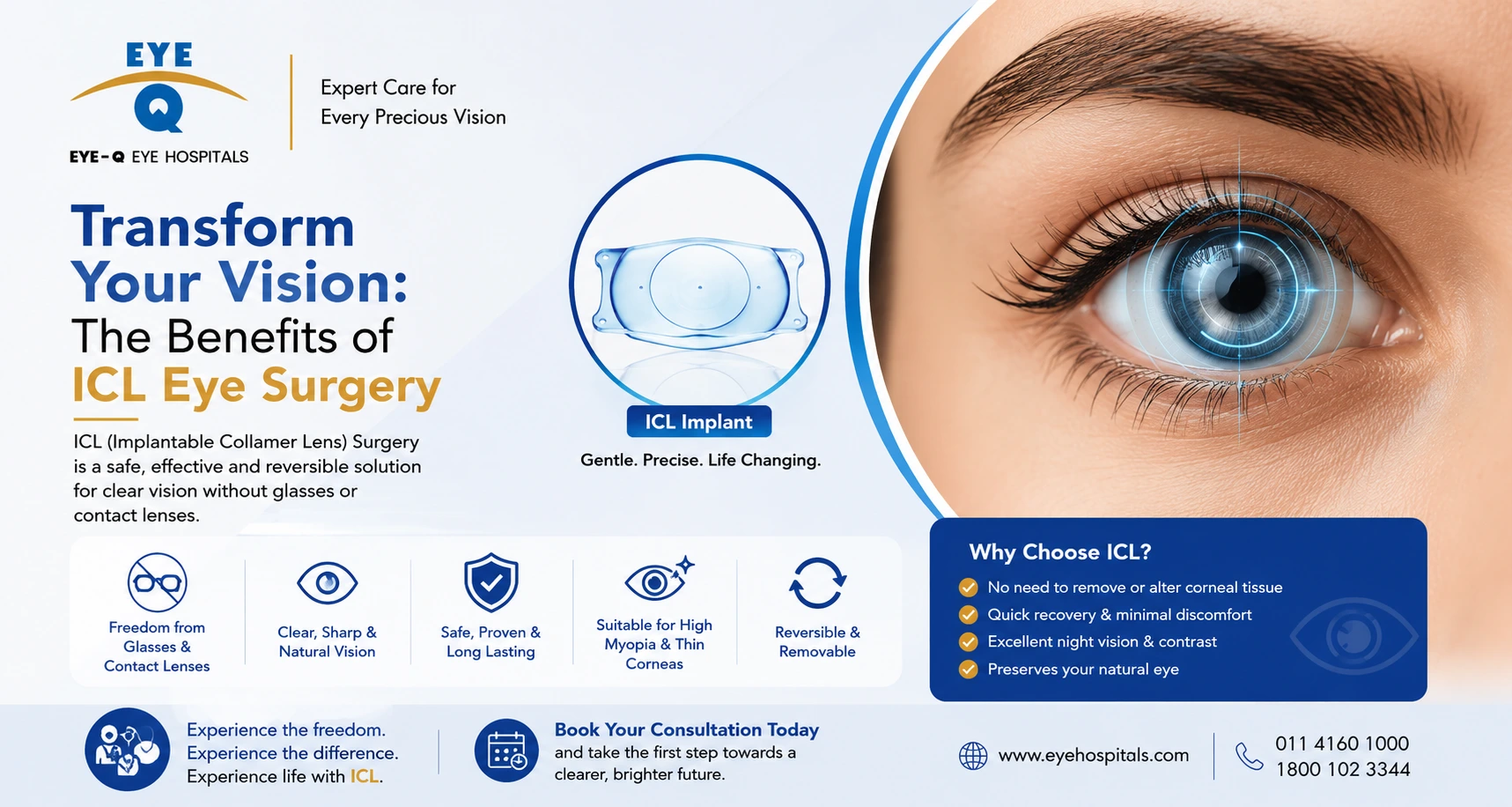
Imagine waking up every morning with sharp, clear vision, no glasses on the nightstand, no dry contacts to fumble with. For millions of people in India dealing with moderate to high myopia, hyperopia, or astigmatism, this is exactly what ICL eye surgery offers. In this comprehensive guide, we break down everything you need to know, the full form, procedure, benefits, pros and cons, recovery time, and realistic costs.
What is ICL Eye Surgery? (Full Form & Overview)
ICL stands for Implantable Collamer Lens, sometimes also referred to as Implantable Contact Lens. It is a refractive surgery procedure in which a biocompatible, soft lens is surgically placed inside the eye, just behind the iris and in front of the natural crystalline lens.
Unlike LASIK surgery, which permanently reshapes corneal tissue to correct vision, ICL works as a supplementary lens that augments the eye’s natural focusing power. The Collamer material is derived from collagen, making it highly biocompatible and accepted naturally by the human eye.
Key Fact: The EVO Visian ICL, the most widely used ICL in India is FDA-approved and has been implanted in over 1 million eyes worldwide, with a strong long-term safety record.
ICL is particularly effective for patients with prescriptions ranging from 3D to −20D (myopia), up to +10D (hyperopia), and astigmatism up to 6D. If you’ve been told LASIK isn’t suitable due to a thin cornea or high prescription, ICL may be the better alternative.
How ICL Surgery Works Step by Step
- Pre-surgery assessment: Your Eye-Q surgeon performs a full eye examination including corneal topography, anterior chamber depth measurement, and retinal evaluation to confirm ICL suitability and custom-size your lens.
- Anaesthetic eye drops: Topical anaesthetic drops are applied no injections, no general anaesthesia. The procedure is performed on an outpatient basis and takes approximately 15–20 minutes per eye.
- Micro-incision and lens placement: A tiny incision (under 3mm) is made at the edge of the cornea. The ICL is folded and gently inserted, then unfolded and positioned between the iris and the natural lens. No corneal tissue is removed.
- Self-sealing and immediate results: The micro-incision seals itself without sutures. Most patients notice dramatically clearer vision within 24 hours of surgery.
Key Benefits of ICL Eye Surgery
ICL eye surgery offers a wide range of clinical and lifestyle advantages, making it one of the most versatile vision correction procedures available today.
HD Quality Vision
The Collamer material transmits light with exceptional clarity, delivering high-definition vision and improved contrast sensitivity often better than glasses ever provided.
Reversible & Removable
Unlike LASIK, ICL is fully reversible. The lens can be removed or replaced at any time — an important safety net as your prescription changes over decades.
No Dry Eye Syndrome
Because ICL doesn’t involve cutting corneal nerves, it does not cause dry eye a common side effect reported after LASIK. Ideal for patients who already experience mild dryness.
Built-in UV Protection
The EVO Visian ICL lens has an integrated UV blocker that filters both UVA and UVB rays, providing long-term protection against UV-related eye conditions.
Cornea Fully Preserved
No corneal tissue is permanently removed or altered. This preserves future surgical options, including cataract surgery, and is critical for patients with thin or sensitive corneas.
Fast Recovery
Most patients resume normal daily activities within 24–48 hours. Many report visible improvement in vision clarity on the very day of surgery.
ICL Eye Surgery: Pros and Cons
Like any surgical procedure, ICL has both advantages and limitations. Here is a balanced look at ICL eye surgery pros and cons to help you make an informed decision:
Like any surgical procedure, ICL has both advantages and limitations. Here is a balanced look at ICL eye surgery pros and cons to help you make an informed decision:
✓ Pros of ICL Surgery
|
✗ Cons of ICL Surgery
|
Our experienced Eye-Q ophthalmologists will assess your individual profile and explain which option is right for you during a thorough pre-surgical consultation.
ICL vs LASIK , Which is Right for You?
Both ICL and LASIK eye surgery are safe and effective for vision correction, but they suit different patient profiles. Here’s how they compare:
| Factor | ICL Surgery | LASIK Surgery |
|---|---|---|
| Corneal reshaping | No, additive lens | Yes, removes tissue |
| Prescription range | Up to −20D / +10D | Up to −12D typically |
| Thin cornea suitability | Yes, suitable | Not recommended |
| Dry eye risk | Very low | Moderate risk |
| Reversibility | Fully reversible | Permanent |
| Recovery time | 24–48 hours | 24–72 hours |
| UV protection | Built-in UV blocker | Not included |
| Cost (per eye) | ₹75K–1.5L | ₹30K–80K |
| Night vision quality | Excellent | Good to very good |
Not sure which procedure suits you? Eye-Q offers a complimentary pre-surgery evaluation where our specialists will map your cornea, measure your prescription, and recommend the most suitable option, LASIK, ICL, or another corrective procedure. Book your evaluation
Recovery Time, What to Expect After ICL Surgery
Day of Surgery
Rest at home. Mild light sensitivity is normal. Avoid screens for 4–6 hours. Prescription eye drops will be provided by your Eye-Q surgeon.
Day 1 — First Follow-up
Your Eye-Q surgeon will check the eye at a follow-up appointment. Vision is noticeably clearer. Light desk work is typically permitted.
Week 1–2
Resume driving, desk work, and light exercise. Avoid swimming, rubbing the eyes, and dusty environments.
Month 1+
Final post-op review. Vision fully stabilised. Annual check-ups are recommended to monitor lens position and eye pressure.
Most patients find the surgery far less disruptive to daily life than they expected. Prescription eye drops are used for the first few weeks to prevent infection and manage inflammation.
ICL Eye Surgery Cost in India (2026)
Average ICL Surgery Cost in India (2026): ICL eye surgery typically costs between ₹75,000 to ₹1,50,000 per eye. Both eyes together may range from ₹1.5 lakhs to ₹3.6 lakhs, depending on the lens type, surgeon expertise, hospital, and diagnostics.
The main factors that influence the cost of ICL eye surgery are:
- Lens type: Toric ICL (for astigmatism) costs slightly more than spherical ICL
- Lens brand: EVO Visian ICL (imported) vs Indian generic options
- Surgeon’s expertise: Fellowship-trained refractive surgeons may charge a premium
- Pre-surgery diagnostics: Corneal mapping, OCT, retinal evaluation
- Post-operative medications and follow-up visits
At Eye-Q, our ICL packages are fully transparent with no hidden charges. Book a consultation and our team will provide a personalised cost estimate after your eye evaluation.
Who is an Ideal Candidate for ICL Surgery?
ICL eye surgery is generally recommended for patients who:
- Are between 21 and 45 years of age with a stable prescription for at least 12 months
- Have moderate to high myopia (−3D to −20D) or hyperopia (+1D to +10D)
- Have been told they are not suitable for LASIK due to thin corneas, large pupils, or dry eyes
- Have adequate anterior chamber depth for lens placement
- Have no history of glaucoma, active uveitis, or significant cataracts
ICL may not be ideal for patients with very shallow anterior chambers, uncontrolled eye pressure, or those above 45 who may benefit more from a refractive lens exchange. Our surgeons will advise the most appropriate procedure after a complete examination.
ICL eye surgery is a remarkable advancement in vision correction offering HD-quality results, reversibility, corneal preservation, and suitability for patients who can’t have LASIK. Whether you’re struggling with strong glasses, uncomfortable contact lenses, or have been turned away for laser surgery, ICL may be the transformative solution you’ve been looking for.
At Eye-Q, our refractive surgery team uses the latest diagnostic technology and EVO Vision ICL lenses to deliver outcomes with precision and care. From your first consultation to your post-op recovery, we are with you every step of the way.
Explore More on Eye-Q India
→ Refractive & ICL Surgery at Eye-Q
Frequently Asked Questions
How much does ICL cost per eye?
ICL eye surgery in India typically costs between ₹75,000 to ₹1,50,000 per eye. Total cost depends on lens type (Toric or Spherical), surgeon’s experience, hospital facilities, and pre-operative tests. At Eye-Q, we provide a detailed cost breakdown after your initial eye evaluation so there are no surprises. Book a consultation
Is ICL surgery safe?
Yes, ICL surgery has an excellent safety profile. The EVO Visian ICL is FDA-approved and has been used in over a million procedures globally. Because ICL does not remove corneal tissue, the risks associated with corneal thinning (seen in some LASIK cases) do not apply. All surgical procedures carry some risk, which your Eye-Q surgeon will discuss in detail during consultation.
Which age is best for ICL surgery?
ICL surgery is ideally performed between the ages of 21 and 45, when the prescription has been stable for at least one year. Below 21, prescriptions may still be changing. Above 45, natural lens changes may affect the outcome. Each patient is assessed individually based on eye health and prescription stability.
How painful is ICL surgery?
ICL surgery is virtually painless. Anaesthetic eye drops numb the eye before the procedure begins. Most patients report feeling only mild pressure or light sensitivity during or just after surgery. Discomfort, if any, typically resolves within a few hours. Oral pain relief is rarely needed.
Which eye surgery is safest?
Both ICL and LASIK are considered safe when performed on suitable candidates by experienced surgeons. ICL tends to be preferred for patients with thin corneas, high prescriptions, or pre-existing dry eye. Eye-Q’s specialist surgeons will evaluate your eyes thoroughly and recommend the safest and most effective option for your specific profile.