


Quick Summary
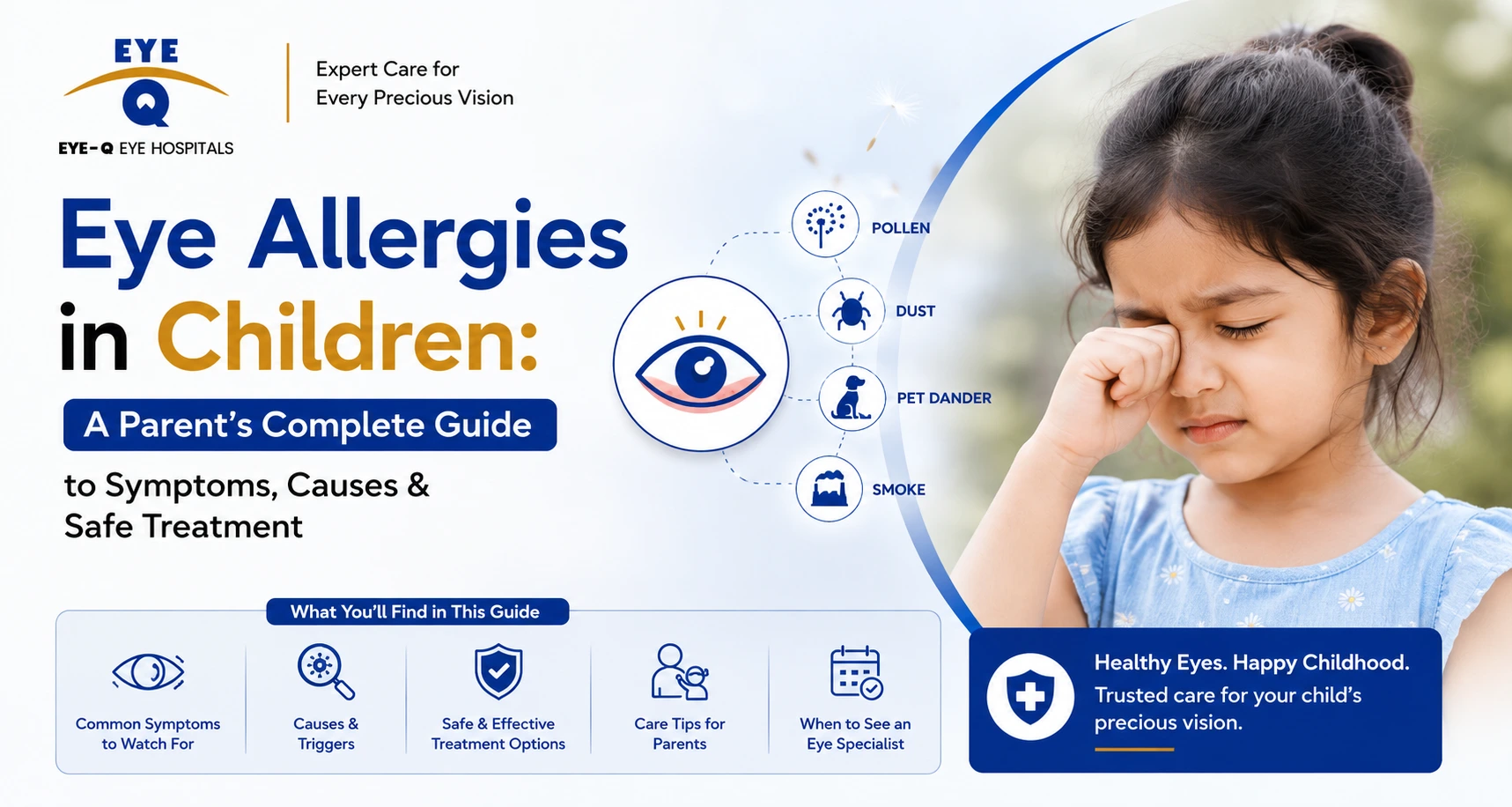
Eye allergies in children happen when the eyes overreact to harmless triggers like pollen, dust, pet dander, or smoke releasing histamine that causes itching, redness, watering and swelling. The medical name is allergic conjunctivitis.
The single biggest clue it’s an allergy and not an infection is itching, usually in both eyes, with no fever. Most cases are mild and settle with allergen avoidance, cold compresses, and doctor-advised eye drops.
The important part many parents miss: a more severe form called VKC is common in Indian children and can threaten sight if ignored. This guide shows you exactly when home care is enough and when to see an eye doctor.
If your child keeps rubbing their eyes, blinking hard, or complaining that their eyes “feel itchy,” it’s natural to worry. The good news is that most childhood eye allergies are uncomfortable but harmless, and they respond well to simple care once you know what you’re dealing with.
But not every red, watery eye is a harmless allergy — and not every allergy is mild. As eye specialists, we often meet parents who waited too long, or who used the wrong drops bought over the counter. This guide is written to help you tell the difference confidently, act early, and know exactly when your child needs a doctor.
What Are Eye Allergies in Children?
An eye allergy, medically called allergic conjunctivitis, happens when the thin, clear layer covering the white of the eye (the conjunctiva) reacts to something that is actually harmless. The child’s immune system mistakes the allergen — pollen, dust, dander — for a threat and releases histamine. Histamine is what causes the classic itch, redness, watering and puffiness.
Children are especially prone because their eyes are still developing, they spend more time outdoors and on the floor (closer to dust), and they rub their eyes far more than adults — which only releases more histamine and worsens the cycle.
Signs & Symptoms to Watch For
Younger children often can’t describe what’s wrong, so parents have to read the signs. Look for:
- Frequent eye rubbing — often the very first clue in toddlers
- Itching — the hallmark of allergy (children may say their eyes “tickle”)
- Redness in the white of both eyes
- Watery, clear discharge or stringy mucus
- Puffy or swollen eyelids, sometimes worse on waking
- Sensitivity to light (squinting in sunlight)
- Dark circles under the eyes (“allergic shiners”)
- Sometimes a runny nose or sneezing alongside the eye symptoms
Allergy or Infection? How to Tell the Difference
This is the question that brings most parents to us — and getting it right matters, because the treatments are completely different. Antibiotics do nothing for an allergy, and allergy drops won’t cure an infection.
| Clue | Allergy (Allergic Conjunctivitis) | Infection (Viral/Bacterial) |
|---|---|---|
| Itching | Intense — the main symptom | Mild or absent |
| Which eye | Usually both eyes together | Often starts in one eye |
| Discharge | Watery / clear, stringy | Thick yellow or green, sticky |
| Eyelids stuck shut in morning | Rare | Common (bacterial) |
| Fever / unwell | No | Sometimes (viral) |
| Contagious | No | Yes — keep home from school |
| Pattern | Returns with seasons / triggers | One-off, clears in 1–2 weeks |
Quick rule of thumb: Itchy + both eyes + watery + no fever = most likely allergy. Sticky discharge + gluey lids + maybe fever = more likely infection. If you’re unsure, don’t guess — an eye check settles it in minutes.
Common Triggers — Including Ones Specific to India
Identifying the trigger is half the battle. Triggers fall into a few groups:
- Seasonal: tree, grass and flower pollen — worst in spring and during seasonal changes.
- Indoor / year-round: dust mites, mould, and pet dander from cats and dogs.
- Environmental irritants: air pollution, vehicle smoke, and chalk dust at school.
- Contact triggers: soaps, shampoos, swimming-pool chlorine, or rubbing the eyes with dirty hands.
What sets the Indian picture apart is well documented. A large nationwide study by the ICMR found that allergic eye disease in children was significantly more likely with exposure to dust and pollution, bright sunlight, and even the smoke from incense sticks (agarbatti and dhoop) commonly burnt in Indian homes. Hot, humid and dusty conditions across much of the country make childhood eye allergies both more common and, at times, more severe than in cooler climates.
Your Child’s Eye-Allergy Calendar
Many parents notice symptoms flare at the same time each year. Knowing the pattern lets you start prevention before the season hits:
| Season | Main triggers | What helps |
|---|---|---|
| Spring (Feb–Apr) | Tree & flower pollen — peak VKC season | Sunglasses outdoors, start preventive drops early |
| Summer (May–Jun) | Dust, dry winds, bright sun | Limit midday outdoor play, wraparound sunglasses |
| Monsoon (Jul–Sep) | Mould, damp indoor allergens | Keep rooms dry & ventilated, clean damp corners |
| Winter (Oct–Jan) | Dust, pollution/smog, indoor dust mites | Air purifier, wash bedding hot, mask on smoggy days |
VKC: The Serious Eye Allergy Every Indian Parent Should Know
Most eye allergies are mild. But there is one type that deserves special attention because it is both common in India and potentially sight-threatening: Vernal Keratoconjunctivitis (VKC).
VKC is a chronic, recurring allergic condition that mainly affects boys between about 5 and 15 years of age, and is far more common in hot, humid, dusty regions such as India, the Mediterranean and central Africa. It tends to flare in spring (hence “vernal,” meaning spring) and quietens in cooler months — though many Indian children have year-round symptoms.
What makes VKC different from an everyday allergy:
- Extreme itching — far more intense than ordinary allergy
- Strong light sensitivity — children may avoid sunlight or keep eyes shut outdoors
- Thick, ropy, stringy mucus discharge
- A “cobblestone” appearance of bumps under the upper eyelid (seen by a doctor)
- A constant feeling of something in the eye
The reason VKC matters: left unmanaged, the chronic inflammation can damage the cornea — the clear front window of the eye — leading to shield ulcers, scarring, or a cone-shaped cornea (keratoconus) that permanently affects vision. The reassuring news is that with timely, specialist-guided treatment, the vast majority of children do very well. This is exactly why an eye allergy that is severe, persistent, or recurring should always be assessed by an ophthalmologist rather than self-treated.
Red Flags — See an Eye Doctor Promptly If Your Child Has:
- Eye pain (not just itch) or a constant gritty, foreign-body feeling
- Light sensitivity that makes the child keep eyes closed
- Blurred vision or complaints that they “can’t see properly”
- Thick discharge, or eyelids that look very swollen
- Symptoms lasting more than a few days, or returning every season
- Constant, uncontrollable rubbing — a common sign of VKC
Treatment Options & Safe Eye Drops for Children
Treatment is matched to severity and should be guided by an eye doctor — especially for children, whose eyes are still developing. The main options include:
1. Antihistamine eye drops
Work quickly to block the itch and redness during a flare-up. Good for short-term, fast relief.
2. Mast-cell stabiliser drops
Prevent histamine from being released in the first place. They work best when started before the allergy season and used regularly — ideal for children with predictable seasonal allergies.
3. Combination (dual-action) drops
Many modern drops both relieve and prevent symptoms, which is convenient for children.
4. Artificial tears (lubricating drops)
Preservative-free artificial tears physically flush allergens off the eye’s surface and soothe irritation. Safe and useful for mild cases.
5. Steroid drops — only under supervision
Powerful and sometimes necessary for severe allergy or VKC — but only ever under an ophthalmologist’s close supervision. Unsupervised long-term steroid drops in children can cause glaucoma and cataract, which is why these should never be bought over the counter or reused from a past prescription.
Safe Home Care for Mild Cases
- Cold compress: a clean, soft cloth chilled in the fridge, placed over closed eyes for a few minutes, calms itching and swelling.
- Rinse the allergens away: gently wash your child’s face and eyelids after outdoor play.
- Lubricating drops: preservative-free artificial tears to flush out irritants.
- Cut the rubbing: keep nails short and gently remind your child — rubbing makes everything worse.
- Cool, clean rooms: wash bedding in hot water, vacuum regularly, and avoid burning incense near the child.
Do’s & Don’ts for Parents
✓ Do
- Use a cold compress for instant relief
- Identify and remove the trigger
- Use only doctor-advised eye drops
- Send sunglasses/cap to school in pollen season
- See a doctor if it recurs every year
✕ Don’t
- Let your child rub their eyes
- Buy steroid drops over the counter
- Reuse old prescriptions or a sibling’s drops
- Use breast milk, kajal or home “remedies” in the eye
- Ignore pain, light sensitivity or blurring
How to Prevent Flare-Ups
- Track the season: begin preventive drops (as advised) before the flare period starts.
- Reduce indoor allergens: dust-mite-proof covers, frequent washing of soft toys and bedding, and good ventilation.
- Filter the air: an air purifier helps on high-pollution and smoggy days.
- Shield the eyes: wraparound sunglasses block pollen, dust and UV during outdoor play.
- Build the habit of hand-washing and not touching the eyes.
Managing Eye Allergies on School Days
Allergies often peak at school — chalk dust, playground pollen, and shared spaces all add up, and itchy eyes make it hard for a child to concentrate or read the board. A few practical steps help:
- Pack a small bottle of preservative-free artificial tears (with the teacher informed).
- Send sunglasses or a cap for outdoor periods in allergy season.
- Remind your child to wash hands before touching their face.
- Tell the class teacher it’s an allergy, not an infection — so your child isn’t unnecessarily sent home.
- If eye symptoms are affecting reading or the blackboard, book an eye exam — what looks like an allergy can sometimes accompany an undiagnosed vision problem.
Key Takeaways
- Itching in both eyes with no fever usually means an allergy, not an infection.
- Most cases are mild and ease with allergen avoidance, cold compresses, and doctor-advised drops.
- Never use steroid or over-the-counter redness drops in children without an eye doctor’s guidance.
- VKC is a more serious, India-common form that can affect vision — severe or recurring allergies need a specialist.
- See a doctor for pain, light sensitivity, blurred vision, or constant rubbing.
Frequently Asked Questions
How do I know if my child has an eye allergy or an eye infection?
Allergies cause intense itching, usually in both eyes, with watery clear discharge and no fever. Infections more often start in one eye, cause a gritty or painful feeling, and produce thick yellow or green sticky discharge — sometimes with fever, and they’re contagious. Itching is the strongest sign of an allergy. If you’re unsure, an eye check confirms it quickly.
Are allergy eye drops safe for children?
Yes, when prescribed by an eye specialist for your child’s age. Antihistamine and mast-cell-stabiliser drops are commonly used and safe. Steroid drops can help in severe cases but must only be used under an ophthalmologist’s supervision, as unsupervised use can cause glaucoma and cataract. Avoid over-the-counter redness-reducing drops for ongoing use.
What is vernal keratoconjunctivitis (VKC) in children?
VKC is a chronic, severe form of eye allergy that mostly affects boys aged 5–15 in hot, humid, dusty climates like much of India. It causes intense itching, strong light sensitivity, thick ropy discharge, and a cobblestone appearance under the upper eyelid. Unlike simple allergies, VKC can scar the cornea and threaten vision if untreated, so it needs specialist care.
What home remedies relieve eye allergies in children?
A clean cold compress over closed eyes, preservative-free artificial tears to rinse out allergens, washing the face and hands after outdoor play, and stopping the child from rubbing their eyes all help. Avoid home “remedies” like kajal or breast milk in the eye. Home care eases mild symptoms but doesn’t replace medical treatment for moderate or severe cases.
When should I take my child to an eye doctor for allergies?
See a doctor if there’s eye pain, light sensitivity, blurred vision, swelling that won’t settle, symptoms lasting more than a few days, thick discharge, or constant rubbing. These can point to a more serious condition like VKC or a corneal problem that needs prompt treatment.
Why do my child’s eye allergies keep coming back every year?
Recurring seasonal flare-ups usually mean predictable triggers — spring pollen, summer dust, or indoor allergens like dust mites and pet dander. In India, incense smoke and bright sunlight are also linked to childhood allergic eye disease. Identifying these triggers and starting a doctor-guided prevention plan before the season reduces how often allergies return.
Medical Disclaimer
This article is for general information only and is not a substitute for professional medical advice, diagnosis, or treatment. Every child is different. Always consult a qualified ophthalmologist before starting or stopping any eye medication for your child, especially steroid eye drops. If your child has eye pain, light sensitivity, or vision changes, seek prompt medical care.