



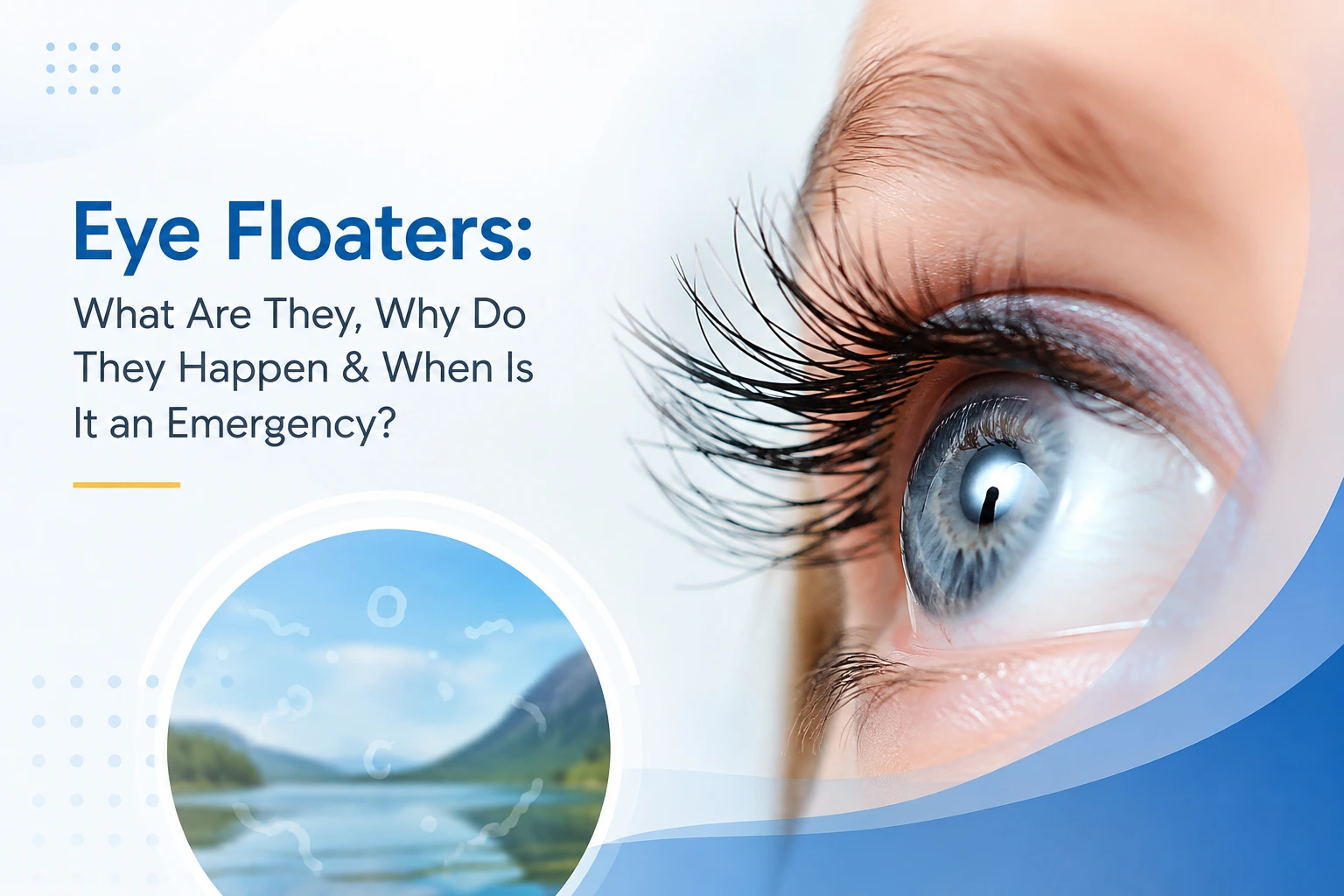
Did you ever come across little spots, lines, rings, or cobwebs floating across your sight? They may be easy enough to chase with your eyes but always seem to move just out of sight. Eye floaters, as these formations are referred to, are fairly common and usually harmless. Yet sometimes a drastic change can signal an emergency.
Having knowledge about the causes of eye floaters will help you determine whether or not it is appropriate to observe them or consult an eye doctor. Knowing about eye floaters will make it possible for you to handle them effectively today. Watching for new eye floaters will help you notice any changes.
What Are Eye Floaters?
Eye floaters are floating objects that may feel like they are moving across your field of vision. These floaters can look like dark spots or threadlike strands. They may also be specks, clouds, or webs. You can see Eye floaters better against backgrounds that are uniform in color. Some of the best backgrounds would be a blank wall, computer screens, or the blue sky.
These floaters are formed inside the vitreous, a transparent, gelatinous substance between the retina and lens. With age, changes occur in the vitreous. This results in the formation of small strands or clumps. These shadows are projected on the retina. Then the brain interprets them as moving objects.
What Causes Eye Floaters?
There are multiple explanations for the cause of eye floaters. In many cases, changes that occur naturally in the vitreous body are responsible for their presence. The vitreous body can be described as a gel-like substance. With age, it might become thin or contract, thus creating new floaters.
Some of the causes of floaters include:
- Vitreous degeneration: This is perhaps the most common cause of floaters. The degeneration of the eye gel results in clumps that shadow the retina.
- Vitreous detachment: The vitreous could detach from the retina. The occurrence might lead to a sudden onset of floaters and sometimes flashing.
- Nearsightedness: Floaters are common among people suffering from myopia, particularly those with high myopia.
- Eye injuries: Trauma or any physical injury to the eye could lead to the formation of new floaters.
- Eye surgeries: Floaters can be an effect of eye surgeries like cataract surgery.
- Infection or inflammation: Intraocular inflammation and the presence of inflammatory cells may cause floaters.
- Hemorrhage: Blood inside the eye may also cause floaters. Diabetics and people who suffer from eye injuries have more chances to develop such floaters.
- Problems with the retina: Sudden onset of numerous floaters along with flashes may indicate that there is a problem with the retina.
Most cases of longstanding floaters do not indicate any hazardous condition.
Eye Floaters Symptoms
The primary eye floaters symptoms will include alterations in vision such as:
- Small dark specks, spots, or dots.
- Thin lines or even squiggly shapes.
- Rings or cobweb-like shapes
- Grey or shadowy shapes.
- Floating objects that seem to drift as the eye moves.
- Eye floaters that become more visible on bright backgrounds.
Eye flashes are not eye floaters, they are a sign that the vitreous is pulling on the retina. Eye flashes accompanied by new eye floaters require immediate examination. Why it’s important is that increased eye floaters indicate a retinal tear or some other retinal disease.
When Are Eye Floaters an Emergency?
Most floaters do not necessitate immediate attention. However, you shouldn’t overlook any sudden changes. Seek immediate eye care in case you experience a sudden development of numerous floaters. It is particularly important when you see them in the form of showers of black spots. You must see a doctor in case you have the following symptoms:
- Flashing lights
- Blurred vision
- Loss of peripheral vision
- Dark shadow
- A curtain moving across your eyes.
These symptoms may indicate a tear or detachment of the retina. Retinal detachment can cause irreversible damage to your vision.
You may experience the onset of new floaters following an injury or surgery to the eye. If that is the case, you need to seek immediate examination.
How Are Eye Floaters Diagnosed?
The eye specialist is likely to inquire about the time of onset of the condition. They may ask whether there has been any change in the number and appearance of the floaters.
The doctor can use a light and a lens to view the back portion of your eye. This examination will help the specialist see if there are any abnormalities. Some of the common ones include retinal tear, detachment, bleeding, or inflammation.
If the retina is healthy and the floaters have been consistent, then no treatment might be needed.
Eye Floaters Treatment
Eye floaters treatment for Stable floaters usually includes observation alone and not through any form of procedure. Many individuals find that their floaters fade over time. It happens as the brain adjusts to their presence. Floaters become a concern when they start affecting one’s vision. They may also, over time, interfere with day-to-day activities.
The treatments include:
- Vitrectomy
Vitrectomy is an operation that involves the removal of all or part of the vitreous gel. The reason for this is that floaters occur inside the gel. There are risks involved in the procedure. This is one of the prime reasons practitioners use it only in special cases when the floaters interfere with vision.
- Laser Treatment
Laser treatment may be recommended for certain large, easily seen floaters. Not all floaters can undergo laser treatment. It is up to the eye specialist to determine if the floater is in a good position for treatment.
- Addressing the Root Cause
In case of floaters due to blood leakage, inflammation, retinal tear, or any other eye disorder, the eye specialist will address this underlying cause. Laser surgery or other such procedures are used in treating retinal tears. Retinal detachment needs surgery.
Can Eye Floaters Eye Drops Help with Floaters?
Eye floaters eye drops are a popular search term, as drops are an easy solution to a problem. Yet, normal eye drops, such as lubricant or moisturizing solutions, do not get rid of floaters located within the vitreous.
Certain drugs that can be administered intravitreally have been explored in the case of eye floaters. But most of them have failed to show definite positive results. One should not use prescription eye drops. One definitely should not purchase any floater eye drops without consulting an eye specialist first.
How to Get Rid of Eye Floaters?
Are you wondering how to get rid of eye floaters? This will depend on why these have occurred and on their effects on your vision. There is no quick fix at home to get rid of vitreous floaters.
For minor floaters that remain stable, patience is key in letting your brain get used to them. The use of sunglasses can also reduce the appearance of floaters.
Consult with an ophthalmologist if your floaters cause problems with reading, driving, working, or other activities. Do not try to eliminate floaters by rubbing or randomly applying eye drops.
Can Lifestyle Changes Prevent Eye Floaters?
It’s not possible to prevent all causes. It’s tough to prevent issues, especially those related to aging of the vitreous fluid. Proper eye care is still very important.
Control health problems like diabetes as prescribed by your doctor. Have your eyes checked on schedule, especially if you are more prone to retinal diseases.
Do not believe products that guarantee a cure.
I Cured My Eye Floaters: Can Floaters Really Go Away?
You may come across statements such as “I cured my eye floaters” online. This does not mean that a specific remedy is applicable to all people in such instances.
These objects may eventually become less visible. Additionally, some of these objects may appear to shift from the central part of vision to other parts. It may give one the impression that the objects have vanished.
Don’t dismiss a sudden disappearance of floaters after having experienced some new symptoms. This could be an indication of an eye condition. If you see some changes like flashes, blurred vision, or a shadow, don’t hesitate to seek medical attention.
Conclusion
Eye floaters are common and usually harmless. These conditions usually occur because the vitreous undergoes degenerative changes as one ages. In most instances, the brain gets used to these floaters. Thus, there is no need for any intervention.
It is important, however, not to take lightly any sudden onset of floaters. Flashes of light, poor eyesight, blind spots, or shadows could indicate an impending retinal tear or detachment. If that’s the case, it might need immediate medical attention.
Seek an eye exam if your floaters are newly developed, evolving, or causing visual disturbances. It is always better to get your harmless floaters checked out in time before it attains the form of a permanent eye disease.
Frequently Asked Questions
What is the major cause of eye floaters?
Aging changes in the vitreous are one of the main causes. Floaters occur as a result of changes in the gel-like consistency of the vitreous. The reason behind it is that it separates from the retina. Other causes include nearsightedness and eye trauma. Also, some people may suffer such issues due to eye surgery, inflammation, hemorrhage, and retinal issues.
How to stop looking at eye floaters?
Do not try to keep chasing a floater using your eyes. Concentrate on your work and avoid the temptation of looking for the floater against a white or bright background. Gradually, your brain will learn how to filter out the constant floater.
Are eye floaters caused by stress?
The onset of stress is not thought to be a common reason for vitreous floaters. Stress can only help you become more conscious of any problems, but the development of any sudden floaters cannot be attributed to stress alone.
Can eye drops help with floaters?
Eye drops are not effective in eliminating floaters, as floaters occur within the vitreous fluid. If you have recently developed any floaters, particularly those that come with flashes, visit an eye specialist rather than relying on drops.
Can eye floaters cause blurred vision?
The floaters may hinder vision, especially if there are many floaters and especially if the floaters are in the central vision. But if blurry vision occurs along with the appearance of floaters, it is an emergency.
What is the difference between eye floaters and flashes?
Floaters appear to be floating spots, lines, rings, or cobwebs. Floaters appear to be floating spots, lines, rings, or cobwebs. New onset of floaters and flashes together could signify a retinal tear or retinal detachment.