



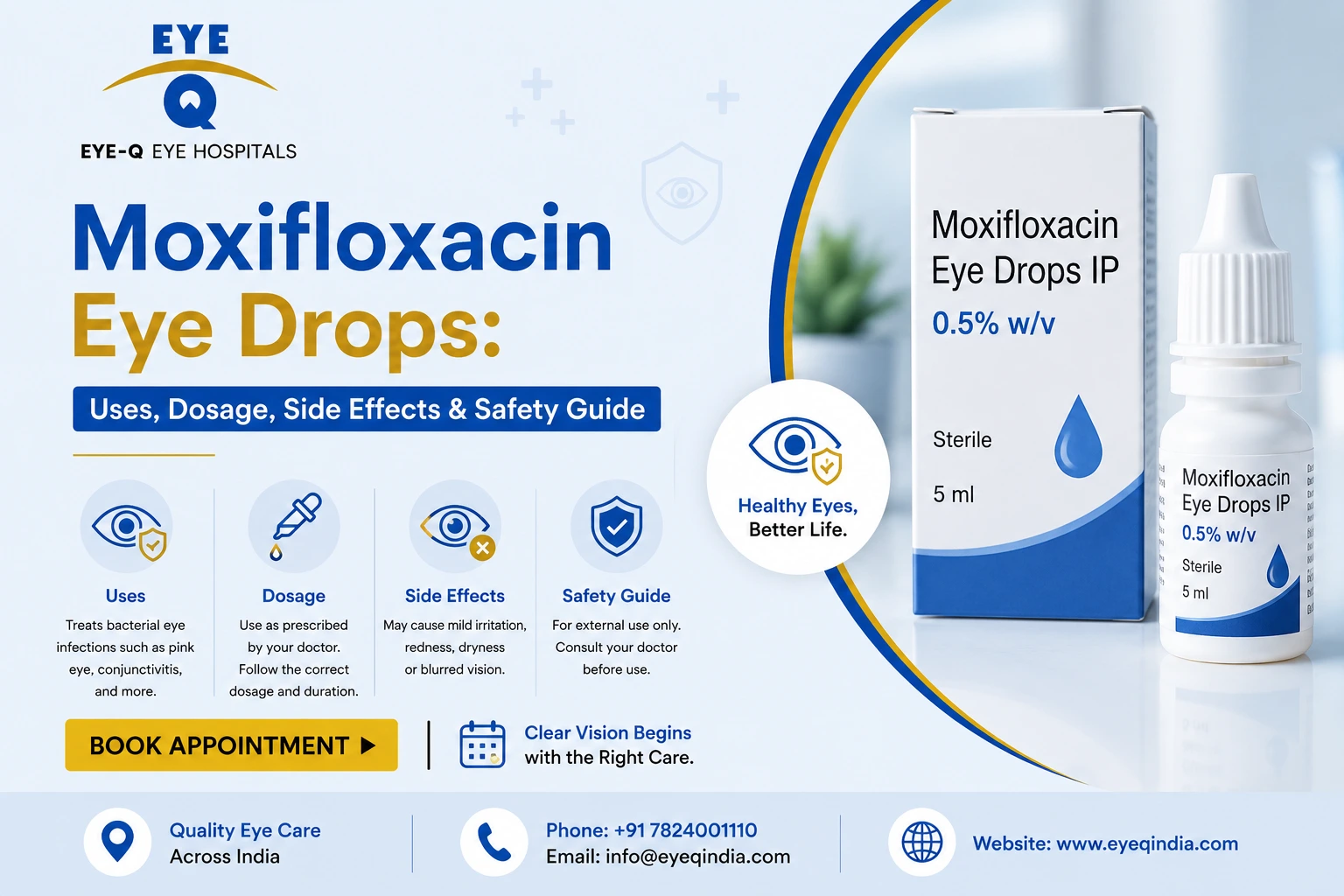
QUICK SUMMARY
Moxifloxacin eye drops are a 0.5% fluoroquinolone antibiotic prescribed to treat bacterial eye infections. They work by blocking bacterial DNA replication enzymes (DNA gyrase and topoisomerase IV), stopping bacteria from multiplying.
Key facts: Treats bacterial conjunctivitis, corneal ulcers, and prevents post-surgery infection. Dosage: 1 drop, 2-3 times daily for 5-7 days. Safe from 4 months of age. Brand names: Vigamox, Moxeza. NOT effective against viral or allergic eye conditions.
What Are Moxifloxacin Eye Drops?
Moxifloxacin eye drops are a 0.5% ophthalmic antibiotic solution that treats bacterial eye infections. They belong to the fluoroquinolone class of antibiotics and are sold under brand names including Vigamox and Moxeza. The Indian Pharmacopoeia version is labelled as Moxifloxacin Eye Drops IP.
How they work: Moxifloxacin blocks two bacterial enzymes – DNA gyrase and topoisomerase IV – that bacteria need to copy and repair their DNA. Without these enzymes, bacteria cannot multiply, and the infection clears. This dual-enzyme blockage also makes moxifloxacin effective against bacteria that have developed resistance to older antibiotics.
Important: Moxifloxacin is an antibiotic. It kills bacteria only. It has no effect on viral conjunctivitis, fungal infections, or allergic eye conditions. Using it for non-bacterial causes is ineffective and contributes to antibiotic resistance.
If you are unsure whether your eye infection is bacterial, book an eye examination at EyeQ India for an accurate diagnosis before starting any antibiotic.
What Is Moxifloxacin Eye Drops Uses For?
Moxifloxacin is a broad-spectrum antibiotic, meaning it works against a wide range of gram-positive and gram-negative bacteria. Here are all its approved clinical uses:
| Condition | What It Treats | Typical Dosage |
| Bacterial Conjunctivitis (Pink Eye) | Most common use. Treats redness, itching, discharge, and swelling caused by bacteria such as Staphylococcus aureus and Haemophilus influenzae. | 1 drop, 2-3 times/day for 5-7 days |
| Corneal Ulcers (Bacterial Keratitis) | Serious infection of the cornea. Moxifloxacin’s ability to penetrate deep eye tissues makes it the preferred antibiotic for this sight-threatening condition. | Frequent initial dosing (every 1-2 hrs); reduce as infection improves |
| Blepharitis (Bacterial) | Infection or inflammation of the eyelid margins caused by bacteria. | As prescribed; usually 2-3 times/day |
| Pre- and Post-Surgery Prophylaxis | Prescribed before and after cataract, LASIK, and other eye surgeries to prevent surgical site infections. | Usually 1-4 days before surgery; 7-14 days after |
| Endophthalmitis Prevention | Used after intravitreal injections and some retinal procedures to prevent internal eye infection. | As per surgical protocol |
Bacteria it targets include: Staphylococcus aureus, Streptococcus pneumoniae, Haemophilus influenzae, Pseudomonas aeruginosa, Moraxella catarrhalis, and many other gram-positive and gram-negative strains.
Related reading: Bacterial Conjunctivitis – Causes, Symptoms & Treatment | Cataract Surgery at EyeQ India | LASIK Eye Surgery
Moxifloxacin Eye Drops vs Eye Ointment
Moxifloxacin is available in both drop and ointment form. Understanding the difference helps you use the right formulation at the right time:
| Feature | Moxifloxacin Eye Drops | Moxifloxacin Eye Ointment |
| Consistency | Liquid, clear or slightly yellow | Semisolid, greasy |
| Best for | Daytime use; mild to moderate infections | Nighttime use; severe infections needing longer contact time |
| Frequency | 2-3 times daily (drops stay in eye briefly) | Once or twice daily (stays in eye longer) |
| Vision impact | Minimal temporary blur after instillation | Significant blurring for 15-30 min after application |
| Patient preference | Easier to apply; less discomfort | Harder to apply; often reserved for children or overnight use |
Moxifloxacin Eye Drops Dosage: How Much and How Often?
Standard Dosage for Adults and Children (4 months and above)
- Bacterial conjunctivitis: 1 drop in the affected eye(s), 2-3 times daily (every 8 hours) for 5-7 days
- Severe infections (corneal ulcers): May be prescribed as frequently as every 1-2 hours initially, reducing as infection improves
- Pre/post-surgery: Usually 1 drop, 4 times daily, starting 1-4 days before surgery and continuing 1-2 weeks after
Complete the full course. Never stop moxifloxacin early even if symptoms improve within 1-2 days. Residual bacteria can survive, causing recurrence or developing antibiotic resistance.
Need a prescription? Consult an ophthalmologist at EyeQ India – available across Gujarat, Haryana, Uttar Pradesh and Uttarakhand.
How to Apply Moxifloxacin Eye Drops Correctly
- Wash your hands thoroughly with soap and water.
- Tilt your head back or lie down. Look up at the ceiling.
- Gently pull down your lower eyelid with one finger to form a small pouch.
- Hold the dropper tip directly above the eye – do not let it touch the eye, eyelid, or your fingers.
- Squeeze one drop into the pouch. Close your eye gently for 1-2 minutes.
- Apply nasolacrimal occlusion: Press lightly on the inner corner of your eye (near the nose) for 1-2 minutes. This prevents the drops draining into your nose and throat, reducing systemic absorption and side effects.
- If using in both eyes, repeat the process for the second eye.
- Replace the cap tightly. Wash your hands again.
If you miss a dose: Apply as soon as you remember. If it is almost time for your next dose, skip the missed one. Never double-dose.
Moxifloxacin Eye Drops Side Effects
Most people tolerate moxifloxacin eye drops very well. The table below covers all known side effects by frequency and what to do:
| Side Effect | Frequency | Details | What to Do |
| Mild burning or stinging after instillation | Common | Usually resolves in 1-2 minutes. Normal reaction. | No action needed |
| Temporary blurred vision | Common | Clears within minutes of application. | Avoid driving immediately after applying |
| Eye redness (hyperemia) | Common | Usually fades within 1-2 days. | Continue drops as prescribed |
| Dry eyes or watery eyes | Common | Mild; both can occur. | Use lubricating drops if needed (consult doctor) |
| Eye pain or increased discharge | Uncommon | May indicate worsening infection. | Contact your doctor within 24 hours |
| Severe allergic reaction (rash, facial swelling, breathing difficulty) | Rare | Serious – requires urgent care. | Stop drops immediately go to A&E |
| Corneal pigment epithelial erosion | Very rare | Seen with prolonged or repeated use. | Review with ophthalmologist |
Stop using the drops and seek medical attention immediately if you develop: sudden vision changes, severe eye pain, signs of allergic reaction (rash, difficulty breathing, swelling of the face or throat), or symptoms that worsen after 3 days of treatment.
Experiencing eye pain or worsening symptoms? Book an urgent eye appointment at EyeQ India
Precautions and Warnings
Who Should Not Use Moxifloxacin Eye Drops
- Allergy to fluoroquinolones: Do not use if you have had an allergic reaction to moxifloxacin, ofloxacin, ciprofloxacin, or any other quinolone antibiotic.
- Viral or fungal eye infections: Antibiotics do not treat these conditions. Using moxifloxacin for viral conjunctivitis (the most common form) is ineffective. See General Eye Care at EyeQ India for diagnosis support.
- Keratoconus: Use with caution; consult your ophthalmologist. Learn about keratoconus and refractive services at EyeQ
Contact Lenses
Do not wear contact lenses while you have active bacterial conjunctivitis. Lenses can harbour bacteria and slow healing. Once your infection is fully cleared and your doctor confirms recovery, clean or replace your lenses before resuming use.
Pregnancy and Breastfeeding
The safety of moxifloxacin eye drops during pregnancy and breastfeeding has not been fully established in controlled clinical trials. Use only if your doctor determines the benefit outweighs the potential risk. Applying nasolacrimal occlusion after instillation reduces systemic absorption.
Children
Moxifloxacin eye drops are safe from 4 months of age. Dosage for children follows the same schedule as adults (1 drop, 2-3 times daily), but must be determined and supervised by a paediatrician or ophthalmologist.
For paediatric eye care, consult EyeQ India’s paediatric ophthalmology specialists
Driving and Operating Machinery
Do not drive or operate machinery immediately after instillation, as temporary blurring of vision may occur for a few minutes.
Storage, Price and Availability in India
- Storage temperature: Store at room temperature between 2 degrees C and 25 degrees C (36-77 degrees F). Do not freeze.
- After opening: Discard the bottle 4 weeks (28 days) after first opening, even if drops remain. Opened bottles can become contaminated.
- Keep away: Store away from direct sunlight, children, and pets.
- Price in India: Moxifloxacin 0.5% eye drops are available from multiple Indian pharmaceutical manufacturers. Prices vary by brand but typically range from Rs. 50 to Rs. 200 per 5 ml bottle. Available at most pharmacies and hospital dispensaries.
- Prescription required: Moxifloxacin eye drops are a prescription-only medicine (POM) in India. Do not purchase or use without a valid prescription from a registered ophthalmologist or medical practitioner.
Get a valid prescription from a certified ophthalmologist. Find an EyeQ India eye specialist near you
- Common Indian brands: Vigamox (Alcon), Moxicip (Cipla), Milflox (Milmed), and several other generics listed under the IP standard.
Moxifloxacin vs Other Antibiotic Eye Drops
How does moxifloxacin compare to other commonly prescribed antibiotic eye drops in India?
| Drop | Class | Main Uses | Coverage | Frequency | Notes |
| Moxifloxacin 0.5% | Fluoroquinolone | Bacterial conjunctivitis, keratitis, post-surgery prophylaxis | Very broad | 2-3x/day | Broad-spectrum; good corneal penetration; preservative-free versions available |
| Ofloxacin 0.3% | Fluoroquinolone | Bacterial conjunctivitis, corneal ulcers | Broad | 4-6x/day | Older fluoroquinolone; narrower coverage than moxifloxacin |
| Ciprofloxacin 0.3% | Fluoroquinolone | Corneal ulcers, bacterial conjunctivitis | Broad | Varies by severity | Strong vs Pseudomonas; more frequent dosing needed |
| Tobramycin 0.3% | Aminoglycoside | Bacterial conjunctivitis, blepharitis | Moderate | 3-4x/day | Often combined with steroid (dexamethasone) |
| Chloramphenicol 0.5% | Amphenicol | Mild bacterial conjunctivitis | Moderate | 4-6x/day | Low cost; broad availability; rarely used long-term due to systemic risk concerns |
Why moxifloxacin is often preferred: Compared to ofloxacin and ciprofloxacin, moxifloxacin offers broader bacterial coverage, requires fewer daily doses, and penetrates corneal tissue more effectively. Preservative-free versions also reduce the risk of ocular surface toxicity with extended use.
Related reading at EyeQ India: Glaucoma Treatment | Retina Treatment | Cataract Surgery
Key Takeaways
- Moxifloxacin eye drops treat bacterial infections only – not viral, fungal, or allergic eye conditions.
- Standard dose: 1 drop, 2-3 times daily for 5-7 days. Always complete the full course.
- Apply correctly: tilt head back, pull lower eyelid, instil 1 drop, press inner corner for 1-2 minutes.
- Do not wear contact lenses during active infection.
- Common side effects (burning, stinging, temporary blur) are mild and brief.
- Store at 2-25 degrees C; discard 4 weeks after opening.
- Prescription required in India. Do not self-medicate – always consult an EyeQ India ophthalmologist
If you think you have a bacterial eye infection, book an eye examination. Early diagnosis and the correct antibiotic ensure fast recovery and prevent complications. Book an appointment at EyeQ India – trusted eye care across 30+ locations in India.
Frequently Asked Questions
What is moxifloxacin eye drops Uses for?
Moxifloxacin eye drops are used to treat bacterial eye infections, including bacterial conjunctivitis (pink eye), corneal ulcers (keratitis), and blepharitis. They are also prescribed before and after eye surgeries such as cataract and LASIK to prevent infection. They do not work on viral or allergic eye conditions.
Which eye drop is best for eye infection?
For bacterial infections, moxifloxacin 0.5% is among the most effective because it has the broadest coverage among fluoroquinolone eye drops, requires only 2-3 doses per day, and penetrates deep into corneal tissue. For severe infections like corneal ulcers, your ophthalmologist may prescribe it at higher frequency. Always consult a doctor before choosing an antibiotic eye drop.
What is the best time to take moxifloxacin eye drops?
Moxifloxacin drops are typically taken 3 times a day, approximately every 8 hours. A simple schedule is morning (8 AM), afternoon (2 PM), and evening (8 PM). Space doses as evenly as possible. If prescribed twice daily, morning and evening works well. Consistency matters more than exact timing.
How many drops of moxifloxacin eye drops per day?
The standard dose is 1 drop in the affected eye(s), 2-3 times per day for most bacterial eye infections (5-7 days total). For severe infections such as corneal ulcers, your doctor may prescribe drops as frequently as every 1-2 hours initially. Always follow your ophthalmologist’s specific prescription.
Can I use moxifloxacin eye drops for pink eye?
Yes, but only if the pink eye is caused by bacteria. Moxifloxacin is highly effective for bacterial conjunctivitis. It does not work for viral conjunctivitis (which is much more common and usually resolves on its own without antibiotics) or allergic conjunctivitis. A proper diagnosis by an eye doctor is essential before using moxifloxacin.
How long do moxifloxacin eye drops take to work?
Most people notice a significant reduction in redness, discharge, and discomfort within 24-48 hours of starting treatment. However, it is critical to complete the full 5-7 day course even after symptoms improve. Stopping early can allow surviving bacteria to develop antibiotic resistance.
Can children use moxifloxacin eye drops?
Yes. Moxifloxacin eye drops are approved for children from 4 months of age. Dosage and frequency are the same as for adults (1 drop, 2-3 times daily), but treatment must always be prescribed by a paediatrician or ophthalmologist. Never self-medicate with antibiotics for children.
What are the side effects of moxifloxacin eye drops?
Common side effects include temporary burning or stinging after instillation, mild redness, and brief blurred vision, all of which usually resolve quickly. Serious side effects such as severe allergic reactions (rash, facial swelling, breathing difficulty) or worsening eye pain are rare but require immediate medical attention.
Medical Disclaimer
This article is for informational purposes only and does not constitute medical advice. Moxifloxacin is a prescription medicine. Always consult a licensed ophthalmologist before starting, stopping, or changing any eye medication.