


Quick Answer
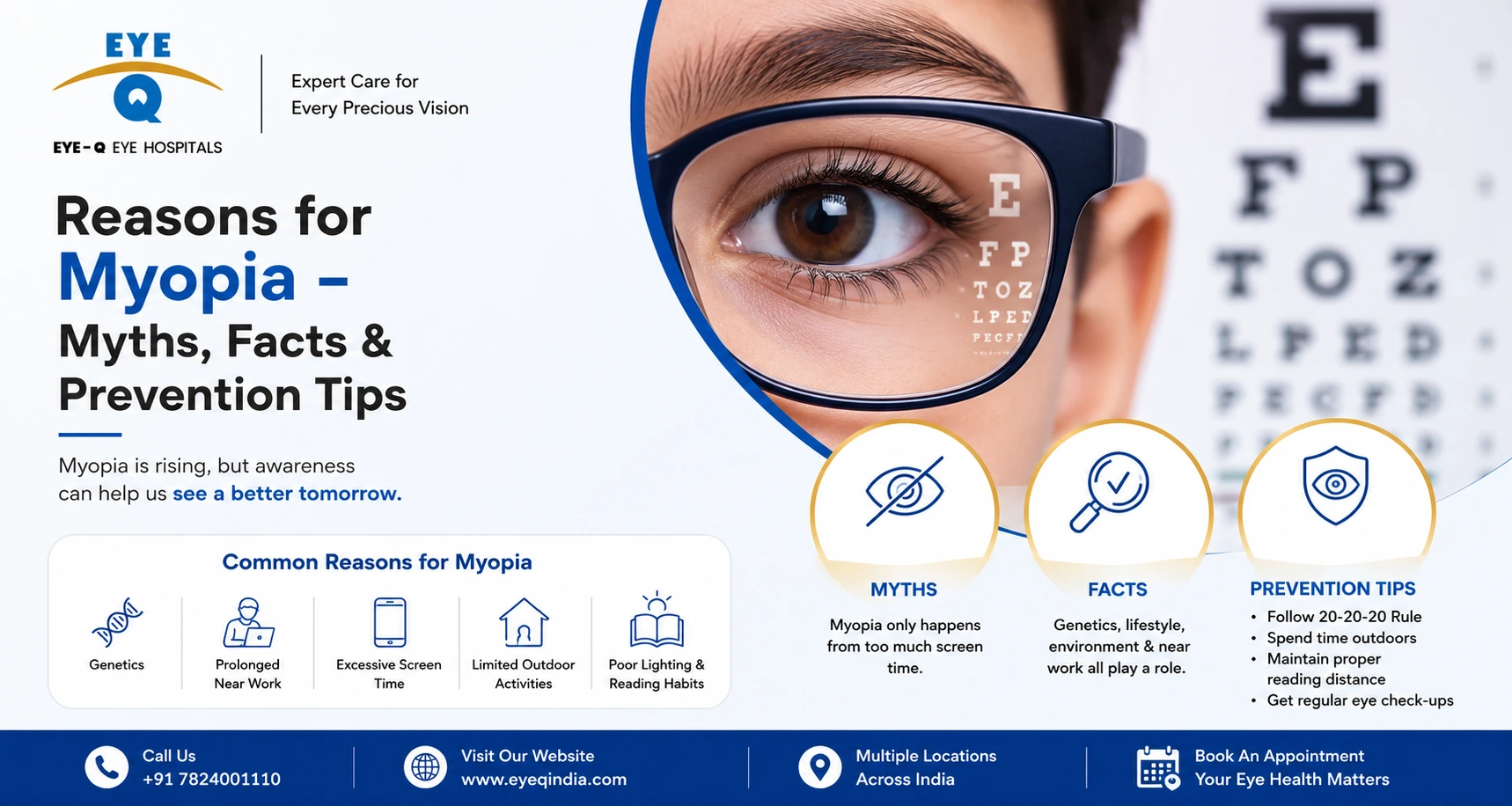
The main reasons for myopia are a combination of genetic predisposition, excessive near work (screen time, reading), and insufficient time spent outdoors. Myopia occurs when the eyeball grows too long, causing light to focus in front of the retina instead of on it making distant objects blurry. While myopia cannot be reversed, its progression can be slowed with the right interventions.
Nearly one in three people in India wears glasses for nearsightedness (myopia) – and that number is growing at an alarming pace. Projections suggest that by 2050, nearly 50% of the world’s population will be myopic, with India alone set to reach a prevalence of over 50% among school-age children in urban areas. Yet despite how common this refractive error is, there is widespread confusion and even more widespread misinformation about why it develops and what can be done about it.
In this blog, the specialists at Eye-Q Super Speciality Eye Hospitals break down the real reasons for myopia, separate verified science from popular myths, and share evidence-backed myopia prevention tips including when treatment becomes necessary. Whether you’re a worried parent noticing your child squinting at the whiteboard, or an adult whose myopia prescription keeps increasing, this guide is for you.
What Is Myopia? Understanding the Basics of Nearsightedness
Myopia, commonly known as nearsightedness or short-sightedness, is a refractive error in which the eye’s optical system focuses light in front of the retina, rather than directly on it. Consequence: Distant objects become blurry while nearby objects remain sharp.
This happens because of a structural mismatch in the eye:
- Axial myopia – the most common type occurs when the eyeball grows too long from front to back (increased axial length)
- Refractive myopia – less common occurs when the cornea is too steeply curved or the crystalline lens has excessive refractive power
Myopia is measured in diopters (D) as a negative number on your glasses prescription. A prescription of -1.00 D is mild; -3.00 D to -6.00 D is moderate to high; above -6.00 D is classified as high myopia, which carries a significantly elevated risk of serious eye complications.
| Classification | Diopter Range | Common Challenges |
|---|---|---|
| Mild myopia | -0.25 to -3.00 D | Difficulty with distant road signs, cinema screens |
| Moderate myopia | -3.00 to -6.00 D | Significant trouble driving and recognizing faces at a distance |
| High myopia | Above -6.00 D | Increased risk of retinal detachment, glaucoma, and cataracts |
| Pathological myopia | Above -6.00 D with structural changes | Possible permanent vision loss; requires specialist care |
The Real Reasons for Myopia: Science-Backed Causes
Understanding the true reasons for myopia requires looking at both biology and lifestyle. Modern ophthalmology now recognizes myopia as a multifactorial condition no single cause is responsible. Instead, it is driven by a complex interaction between genetic, environmental, and behavioral factors.
1. Genetic Predisposition – The Strongest Risk Factor
Hereditary myopia is the single most powerful predictor of whether a child will develop nearsightedness. Research consistently shows:
- If one parent is myopic, a child has a 3× higher risk of developing myopia
- If both parents are myopic, the risk increases to 6× higher than in children with non-myopic parents
- Over 200 genes have been associated with myopia through genome-wide association studies (GWAS)
However, genetics alone doesn’t explain the explosive rise in myopia seen over the past 30 years our genes haven’t changed that fast. This is where environmental factors become critical.
2. Excessive Near Work – Reading, Screens, and Close-Up Activities
One of the most well-established environmental causes of myopia is prolonged near work: activities performed at close range that require sustained visual accommodation, such as reading, writing, and screen use.
When the eye is focused on a close object for extended periods, it may signal the eyeball to grow longer to reduce the focusing effort a process that over time results in axial elongation and myopia. Research from India and globally confirms:
- Children who spend 7 or more hours per week on digital screens are at significantly higher risk of developing myopia
- The “20-20-20 rule” – looking 20 feet away for 20 seconds every 20 minutes is recommended to reduce digital eye strain and near-work-related myopia progression
- Medical students in India a high near work population show disproportionately higher myopia prevalence compared to age-matched non-student groups
Maintain a reading and screen distance of at least 30–40 cm. Avoid reading in dim light. Sit upright rather than lying down while reading or using devices. These simple habits meaningfully reduce visual stress.
3. Insufficient Time Outdoors – The Protective Role of Natural Light
One of the most compelling and consistent findings in recent myopia research is the protective effect of outdoor time. Studies across Asia, Europe, and Australia confirm:
- Children who spend less than 1 hour outdoors daily have significantly higher myopia risk
- Current guidelines recommend at least 2 hours of outdoor activity per day for children to reduce myopia onset risk
- Natural sunlight specifically high-intensity light triggers the release of retinal dopamine, a neurotransmitter that inhibits axial elongation of the eyeball
- Outdoor time is protective independent of the physical activity involved it is the light exposure, not the exercise, that matters most
This explains why the myopia epidemic in India has accelerated alongside urbanization: children are spending more time indoors studying, on screens, and in academically intensive environments, with dramatically reduced outdoor time compared to previous generations.
4. Age of Onset and Childhood Eye Development
Myopia generally starts developing during childhood; the most common age for its occurrence ranges from 8 to 12 years of age. Key facts:
- The earlier myopia develops, the more likely it is to progress to high myopia by adulthood
- Myopia progresses quite quickly during the ages of 11 to 17 years, as these are the ages when the entire body develops rapidly.
- Most cases stabilize in the early-to-mid 20s, though high myopes may continue progressing into their 30s
Early detection is therefore critical. Routine eye examinations at Eye-Q for school-age children can identify myopia before it significantly impacts academic performance, self-esteem, or long-term eye health.
5. Reasons for Myopia Progression in Adults
While myopia most commonly develops in childhood, some adults experience reasons for myopic eye changes even after their prescription appeared stable. Common triggers for adult myopia progression include:
- Sudden increase in near work demands – new academic programs, desk-based careers, or intensive screen use
- Unmanaged diabetes – blood sugar fluctuations cause lens swelling, temporarily inducing or worsening myopia
- Night myopia – reduced lighting causes the pupil to dilate, changing the eye’s refractive state in dim conditions
- Nuclear sclerosis (early cataracts) – the hardening crystalline lens can increase refractive power, mimicking myopia progression in older adults
If you are an adult experiencing a sudden or significant change in your prescription, a comprehensive evaluation at your nearest Eye-Q hospital location is strongly recommended to rule out underlying causes.
Myopia Myths Debunked: What Doesn’t Cause Nearsightedness
| ❌ MYTH: Watching TV too closely causes myopia
There is no clinical evidence that sitting close to a TV causes permanent myopia. Children may sit close because they are already myopic—it is a symptom, not a cause. |
✅ FACT: Extended close-up screen use increases risk over time
It’s the duration of sustained near-focus (not the specific screen type) that matters. Taking frequent breaks reduces the near-work burden on developing eyes. |
| ❌ MYTH: Wearing glasses weakens the eyes and worsens myopia
This is one of the most common myths. Glasses correct vision—they do not make the eyes dependent on them or worsen the underlying prescription. |
✅ FACT: Undercorrected myopia may worsen progression
Clinical evidence suggests that wearing an underpowered prescription may accelerate myopia progression in some children. Proper correction is essential. |
| ❌ MYTH: Eye exercises and carrot diets can cure myopia
There is no scientific evidence that eye exercises, special diets, or supplements can reverse established myopia. The elongation of the eyeball is permanent. |
✅ FACT: A healthy diet supports overall eye health—not myopia reversal
Foods rich in lutein, zeaxanthin, omega-3 fatty acids, and vitamins A and C support eye health and may reduce complications, but they cannot reverse axial elongation. |
| ❌ MYTH: Only children get myopia—adults are safe
Although myopia commonly begins in childhood, adults can develop or experience progression, particularly with prolonged near work or early cataract changes. |
✅ FACT: Myopia can progress in adults, especially in high-demand visual jobs
IT professionals, surgeons, academics, and others with intensive near-work demands should have regular comprehensive eye examinations regardless of age. |
What Are the First Signs of Myopia? Recognizing Symptoms Early
Early recognition of myopia symptoms particularly in children who may not independently report vision problems is one of the most impactful things parents and educators can do. Key first signs of myopia include:
- Squinting when looking at a whiteboard, TV, or distant objects squinting temporarily improves focus by reducing the size of the visual aperture
- Sitting unusually close to the TV or holding reading material very close to the face
- Frequent headaches or eye strain, especially after school or screen time
- Rubbing the eyes excessively a sign of visual fatigue
- Blinking frequently or appearing to “blink to see better”
- Complaints that the blackboard or screen is blurry from their seat in class
- Declining academic performance that correlates with difficulty reading the board
Children often don’t complain about blurry vision because they may assume everyone sees the way they do. Do not wait for your child to report a problem schedule a comprehensive eye examination before school entry, and annually thereafter, especially if there is a family history of myopia.
Why did I suddenly get myopia as an adult? Adults who experience sudden onset of nearsightedness should seek prompt evaluation sudden prescription changes can occasionally signal other conditions such as early nuclear cataract, diabetic lens changes, or keratoconus. Book a comprehensive eye check at Eye-Q to investigate the cause.
Myopia Prevention Tips: Evidence-Based Strategies to Protect Your Child’s Vision
While myopia cannot be completely prevented if there is a strong genetic predisposition, the following strategies have strong scientific evidence for delaying the onset and slowing the progression of myopia especially in children.
1. Maximize Outdoor Time
The single most powerful, accessible, and cost-free intervention for myopia prevention is increasing time spent outdoors. Target at least 2 hours of outdoor activity per day for school-age children. The exact activity is less important than the exposure to bright natural light.
2. Follow the 20-20-20 Rule for Screens
For every 20 minutes of near work or screen time, look at an object at least 20 feet (6 metres) away for at least 20 seconds. This allows the ciliary muscle to relax and reduces the sustained accommodative demand that contributes to myopia progression.
3. Maintain Proper Reading Distance and Posture
Hold reading material and screens at least 30–40 cm from the eyes. Avoid reading lying down or with the book resting on a desk while you lean directly over it. Proper ergonomics reduce the near-work burden on your eyes.
4. Ensure Adequate Lighting
Reading or studying in dim light increases visual strain and may contribute to accommodative stress. Ensure the room is well-lit, with light falling on the page rather than directly in the eyes.
5. Schedule Regular Eye Examinations
Annual comprehensive eye examinations are the cornerstone of early detection and intervention. At Eye-Q hospitals across India, our ophthalmologists perform detailed cycloplegic refractions in children to accurately measure the prescription without accommodative interference – the gold standard for pediatric myopia diagnosis.
6. Clinical Myopia Control Interventions (When Lifestyle Isn’t Enough)
For children with established and progressive myopia, lifestyle measures alone may be insufficient. Evidence-backed clinical interventions include:
| Intervention | How It Works | Best For |
|---|---|---|
| Low-dose atropine eye drops (0.01–0.05%) | Relaxes the eye’s focusing mechanism and helps slow axial elongation. | Children aged 5–18 years with progressive myopia. |
| Orthokeratology (Ortho-K) | Specially fitted overnight lenses temporarily reshape the cornea to slow myopia progression during the day. | Children aged 8–15 years and active or sports-active patients. |
| MiSight / Defocus-incorporating lenses | Creates peripheral myopic defocus to help slow axial elongation. | Children aged 6–12 years; suitable for most lifestyles. |
| LASIK / SMILE / SILK surgery | Permanently reshapes the cornea to correct refractive error. | Adults aged 18+ with stable myopia (does not slow progression). |
| ICL (Implantable Collamer Lens) | A soft lens implanted inside the eye to correct high myopia. | Adults with high myopia (-3D to -20D) who are unsuitable for LASIK. |
Eye-Q offers the full spectrum of myopia correction and control – from LASIK eye surgery and refractive services to ICL procedures for patients with high myopia who are not LASIK candidates. If you’re wondering which treatment is right for you, our team provides a detailed pre-surgical evaluation at all 30+ centers across India.
Which Foods Reduce Myopia? Nutrition and Lifestyle for Eye Health
While no food can reverse myopia, certain nutrients support the health of the retina and may slow degenerative changes particularly important for patients with high myopia who face elevated risk of retinal complications.
- Lutein and zeaxanthin (spinach, kale, corn, eggs) – protect the macula and retina from oxidative damage
- Omega-3 fatty acids (fish, flaxseed, walnuts) – anti-inflammatory; support tear production and retinal health
- Vitamin A (carrots, sweet potato, liver) – essential for rhodopsin production; supports night vision
- Vitamin C (citrus, amla, guava) – antioxidant protection against oxidative stress in the lens and retina
- Zinc (pumpkin seeds, meat, legumes) – required for transporting vitamin A from the liver to the retina
If you’re also experiencing dry eyes alongside myopia, our general eye care specialists at Eye-Q can help with a combined treatment plan addressing both conditions.
Why High Myopia Is More Than Just a Strong Prescription: Complications to Know
One of the most important reasons to take reasons for myopia progression seriously is that untreated or rapidly advancing myopia particularly high myopia above -6.00 D significantly increases the risk of serious, potentially blinding eye conditions:
- Retinal detachment – high myopes have up to 10× the risk of retinal detachment compared to those without myopia
- Myopic maculopathy – stretching of the retina causes degeneration of the macular area responsible for sharp central vision
- Glaucoma – elevated intraocular pressure combined with structural changes in high myopia increases glaucoma risk
- Early cataracts – high myopes develop lens opacity at younger ages than the general population
- Posterior vitreous detachment (PVD) – vitreous gel separates from the retina earlier in elongated myopic eyes
If you are myopic and experience sudden flashes of light, a shower of new floaters, a “curtain” across part of your vision, or sudden worsening of one eye’s vision seek immediate evaluation. These may indicate retinal detachment, which is a medical emergency. Eye-Q’s retina specialists are available at multiple centers across India.
Patients with high myopia should have annual dilated retinal examinations not just routine vision checks. Early detection of peripheral retinal changes, lattice degeneration, or vitreous traction allows for preventive laser treatment before a detachment occurs. Book a retinal evaluation at Eye-Q today.
At What Age Does Myopia Usually Start – and When Does It Stop Progressing?
One of the most common questions parents ask our ophthalmologists is: “When will my child’s myopia stop getting worse?”
- Age of onset: most commonly between 8 and 12 years of age
- Fastest progression: the pre-teen and early teenage years (10–15 years), when the body grows most rapidly
- Stabilization: approximately 50% of patients stabilize by age 15; the majority by their mid-20s
- High myopia exception: patients with high myopia (-6.00 D or above) may continue progressing into adulthood and should be monitored annually regardless of age
The best age to treat myopia surgically – if surgery is the chosen route – is when the prescription has been stable for at least 12 consecutive months. LASIK at Eye-Q is available from age 18 onward, subject to a comprehensive pre-surgical screening. For high myopes with prescriptions above -8.00 D or those unsuitable for LASIK, ICL surgery at Eye-Q offers an excellent alternative with prescriptions corrected up to -20.00 D.
Conclusion: Understanding the Reasons for Myopia Is the First Step to Better Vision
Myopia is not simply a matter of wearing the wrong glasses or sitting too close to the TV. The reasons for myopia are complex rooted in genetic predisposition, amplified by modern indoor lifestyles, and accelerated by reduced outdoor exposure during critical years of eye development. Understanding these causes is the first step toward protecting your vision and your child’s future sight.
The good news: with the right interventions – from outdoor time and screen hygiene to clinical myopia control and corrective surgery the trajectory of myopia can be meaningfully influenced. At Eye-Q, we treat over 1 crore patients across 30+ centers with NABH-accredited care delivered by doctors trained at AIIMS and India’s premier institutes.
Whether you need a first consultation, a detailed cycloplegic refraction for your child, myopia control advice, or are considering LASIK or ICL surgery, book an appointment at your nearest Eye-Q center across Gujarat, Haryana, Uttar Pradesh, and Uttarakhand.
Frequently Asked Questions
Why did I suddenly get myopia?
What are the first signs of myopia in children?
At what age does myopia usually start?
Which foods reduce myopia?
What is the best age to treat myopia with surgery?
The recommended minimum age for LASIK surgery is 18 years, and the prescription must be stable for at least 12 consecutive months. For younger patients or those with high myopia unsuitable for LASIK, ICL surgery (Implantable Collamer Lens) is an option, usually from age 21. Eye-Q’s refractive surgery specialists can assess your eligibility with a thorough pre-surgical evaluation.