

QUICK ANSWER
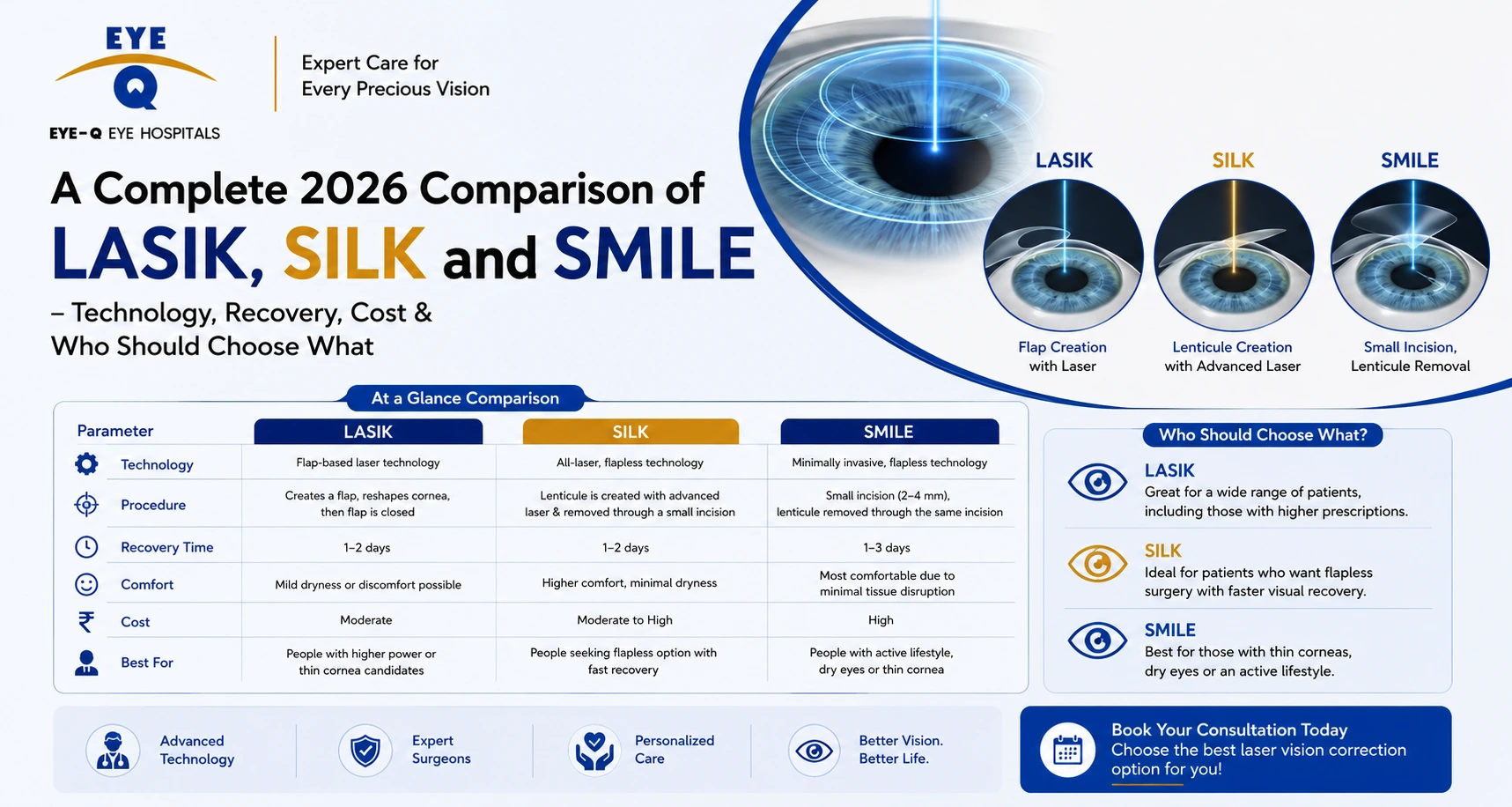
LASIK creates a corneal flap to reshape tissue. SILK (Smooth Incision Lenticule Keratomileusis, developed by Johnson & Johnson Vision) and SMILE are both flapless – they remove a disc of corneal tissue (lenticule) through a small incision of 2-4 mm.
SILK is the newest of the three, using the lowest laser energy (~40 nanojoules), a unique biconvex lenticule design, and ELITA real-time monitoring. It offers the fastest recovery (~24 hours) and the lowest dry eye risk. LASIK has the longest proven track record and widest prescription range. SMILE sits between the two.
What Are LASIK, SMILE and SILK Eye Surgery?
All three are laser vision correction procedures that permanently reshape the cornea to reduce or eliminate the need for glasses or contact lenses. They differ in how they access and remove corneal tissue.
LASIK (Laser-Assisted In Situ Keratomileusis)
LASIK creates a thin flap on the surface of the cornea using a femtosecond laser. The flap is lifted, an excimer laser reshapes the corneal tissue underneath, and the flap is replaced. It is the most widely available and longest-established procedure worldwide.
- Corrects: myopia, hyperopia (farsightedness), and astigmatism
- Unique advantage: the only procedure among the three that currently treats farsightedness (hyperopia)
- Main limitation: the corneal flap can dislodge from impact, and severs more corneal nerves, increasing dry eye risk
Read more : Worried About LASIK Safety? Let’s Talk
SMILE (Small Incision Lenticule Extraction)
SMILE uses a femtosecond laser to carve a disc of corneal tissue (called a lenticule) inside the cornea, which is then extracted through a small 3-4 mm incision. No flap is created.
- Corrects: myopia (up to -10 D) and astigmatism (up to -3 D) – does not treat hyperopia
- Advantage over LASIK: less corneal nerve disruption, lower dry eye risk, no flap dislodgement risk
- Limitation: narrower prescription range than LASIK or SILK; slightly slower recovery than SILK
SILK (Smooth Incision Lenticule Keratomileusis) – The Newest Option
SILK was developed by Johnson & Johnson Vision and is the most recently introduced of the three. It is also flapless and lenticule-based, but uses a second-generation femtosecond laser with the lowest energy output of any current refractive surgery (~40 nanojoules).
What makes SILK technically distinct from SMILE is its biconvex lenticule design (SMILE uses a plano-convex design). This creates a smoother incision, preserves more corneal nerves, and is associated with the lowest post-operative dry eye rates. The ELITA laser platform provides real-time sub-micron precision monitoring.
- 2023 clinical trial: 86% of patients achieved 20/20 vision at 1 week; 96% at 6 months. No major adverse events recorded.
- Corneal preservation: SILK preserves up to 30% more biomechanical strength compared to LASIK
- CE certified: approved for clinical use in India and Europe
Read More : Experience the SILK Procedure: Next-Gen Vision Correction
LASIK vs SILK vs SMILE: Full Comparison Table
The table below compares all three procedures across every key clinical parameter:
| Feature | LASIK | SMILE | SILK (Newest) |
|---|---|---|---|
| Full name | Laser-Assisted In Situ Keratomileusis | Small Incision Lenticule Extraction | Smooth Incision Lenticule Keratomileusis |
| Developed by | Multiple manufacturers | Carl Zeiss Meditec | Johnson & Johnson Vision |
| Technique | Corneal flap created, excimer laser reshapes tissue beneath, flap replaced | No flap – lenticule removed via 3–4 mm incision | No flap – lenticule removed via 2–4 mm incision (biconvex design) |
| Laser type | Femtosecond + Excimer laser | Femtosecond laser only | 2nd-gen femtosecond laser (~40 nanojoules, ultra-low energy) |
| Incision size | Large flap (~18–20 mm) | 3–4 mm | 2–4 mm |
| Recovery time | Few days to 1 week | 2–3 days | 24 hours (fastest) |
| Dry eye risk | Moderate (nerve disruption from flap) | Low | Lowest (better nerve preservation) |
| Corneal strength preserved | ~70% | ~80–85% | Up to 95% |
| Myopia range treated | Up to -12 D | Up to -10 D | Up to -12 D |
| Astigmatism | Yes, up to -6 D | Yes, up to -3 D | Yes, up to -6 D |
| Hyperopia | Yes | No | Under investigation |
| Suitable for thin corneas | Limited | Yes | Yes |
| Vision accuracy (20/20) | ~90% | ~88% | ~96% |
| Flap complication risk | Yes | No | No |
| CE certified | Yes | Yes | Yes |
| Availability in India | Very widely available | Widely available | Growing – select centres |
Which Is Better – SILK or LASIK Eye Surgery?
There is no single ‘better’ procedure – the right choice depends on your prescription, corneal thickness, lifestyle, and dry eye history. Here is how they differ in the areas patients care about most:
Recovery Time
SILK wins on speed. Most SILK patients have functional vision within 24 hours and return to routine activities the next day. LASIK typically takes several days to a week for stable vision, and patients must avoid rubbing or impact to protect the flap.
Dry Eye Risk
LASIK severs a large arc of corneal nerves when the flap is created. This is the primary reason LASIK has a moderate dry eye risk, especially in the first 3-6 months post-surgery. SILK’s smaller incision and biconvex lenticule design disrupts significantly fewer nerves, making it the better option for patients who already have mild dry eye or spend long hours in front of screens.
Prescription Range
LASIK has the widest range. It corrects myopia up to -12 D, hyperopia (farsightedness), and astigmatism up to -6 D. SILK matches LASIK for myopia and astigmatism but does not yet correct hyperopia. SMILE has a narrower range (-10 D myopia, -3 D astigmatism).
Safety and Flap Risk
SILK and SMILE eliminate flap-related risks entirely. LASIK flaps, while extremely rarely problematic, can be dislodged by direct eye trauma, making SILK and SMILE inherently safer for athletes and those in physical professions.
Track Record
LASIK has 25+ years of safety data. SILK is newer, with clinical trials from 2023 showing excellent outcomes, but long-term 10+ year data is still being collected. SMILE has approximately 10 years of global clinical data.
Who Is Eligible for Each Surgery?
Not everyone is a candidate for all three procedures. This table outlines the key eligibility differences:
| Eligibility Criterion | LASIK | SMILE | SILK |
|---|---|---|---|
| Minimum age | 18 years | 18 years | 18 years |
| Prescription stability | At least 1 year | At least 1 year | At least 1 year |
| Corneal thickness | Thicker required | Adequate (thinner ok) | Adequate (thinner ok) |
| Dry eye condition | Mild-moderate acceptable | Better option for dry eye | Best option for dry eye |
| Hyperopia correction | Yes | No | Under investigation |
| Active / contact sports | Avoid post-op; flap risk | Suitable | Best suited (no flap) |
| Pregnancy / lactation | Defer surgery | Defer surgery | Defer surgery |
| Keratoconus | Not suitable | Not suitable | Not suitable |
Who Should Choose Which Surgery? A Decision Guide
Use this guide to match your profile to the right procedure:
| Choose | Best for | Thin corneas | Prescription range | Recovery | Key reason |
|---|---|---|---|---|---|
| SILK | Active lifestyle, sports, contact sports | Yes | Myopia to -12D; astig to -6D | 24 hours | Newest tech; fastest recovery; lowest dry eye risk |
| SMILE | Dry eye sufferers; outdoor workers | Yes | Myopia to -10D; astig to -3D | 2–3 days | Flapless; established 10-year safety record |
| LASIK | Farsightedness (hyperopia); widest range needed | Limited | Myopia, hyperopia, astigmatism | Few days | Only option for hyperopia; 25+ years proven data |
Note: Final suitability must be confirmed through a pre-operative consultation and corneal mapping at a certified eye centre.
LASIK vs SILK vs SMILE Cost in India (2026)
Costs vary by city, centre, technology version, and surgeon experience. The ranges below are indicative for major Indian cities:
| Procedure | Estimated Cost (India, per eye) | Notes |
|---|---|---|
| LASIK (Standard) | Rs. 25,000 – 60,000 | Per eye. Wide availability keeps cost lower. |
| LASIK (Contoura / Topography-guided) | Rs. 40,000 – 80,000 | More precise corneal mapping; higher accuracy. |
| SMILE | Rs. 55,000 – 95,000 | Per eye. Premium flapless option with established safety. |
| SILK | Rs. 65,000 – 1,10,000 | Per eye. Premium pricing reflects newest technology. |
Factors that affect the final cost: pre-operative diagnostics, type of laser platform used, surgeon’s experience, post-operative follow-up package, and whether bilateral (both eyes) discounts apply.
Read More : LASIK Eye Surgery Cost in India 2026 – EyeQ India
Are These Surgeries Safe?
Yes – all three are considered very safe when performed by an experienced surgeon on a suitable candidate. Serious complications occur in fewer than 1% of cases across all three procedures.
- LASIK: long-established with extensive safety data. Main risks: dry eye (temporary in most), halos/glare, rare flap complications.
- SMILE: about 10 years of clinical data. Risks: under correction (small %), suction loss during procedure (very rare).
- SILK: 2023 trial showed 0 major adverse events and 96% achieving 20/20 at 6 months. CE certified. Long-term data (10+ years) still accumulating.
Common post-operative effects for all three (usually temporary): light sensitivity, mild glare/halos at night, fluctuating vision during healing. These typically resolve within 1-4 weeks.
Recovery Timeline Comparison
Here is what to expect after each procedure:
| Timeline | LASIK | SMILE | SILK |
|---|---|---|---|
| Day 1 | Blurry vision, avoid rubbing eyes, use antibiotic drops | Mild discomfort, blurry vision, avoid rubbing | Clear vision beginning within hours, minimal discomfort |
| Day 2-3 | Vision improving; avoid strenuous activity | Vision stabilising; most can read/use screens | Most daily activities resumable; vision largely stable |
| Week 1 | Avoid swimming, dusty environments, eye contact sports | Avoid swimming and contact sports | Follow-up check; avoid pools and impact sports |
| Month 1 | Full healing; some experience glare at night | Full healing; night vision normalising | Vision stable; complete healing within 2–4 weeks |
Key Takeaways
- SILK is the newest technology, offering the fastest recovery, lowest dry eye risk, and highest reported 6-month accuracy (96% achieving 20/20).
- LASIK has the widest prescription range and is the only option for hyperopia. Longest safety track record (25+ years).
- SMILE is the established middle ground: flapless and lower dry eye risk than LASIK, but narrower prescription range than SILK or LASIK.
- No procedure suits everyone: suitability depends on corneal thickness, prescription, lifestyle, and dry eye history. A pre-operative evaluation is essential before any decision.
- Cost guide (India, per eye): LASIK from Rs. 25,000; SMILE from Rs. 55,000; SILK from Rs. 65,000.
Ready to find out which procedure suits you? Book a pre-operative consultation and corneal mapping at a certified refractive surgery centre. Book an appointment – EyeQ India
Frequently Asked Questions
Which is better – SILK or LASIK surgery?
SILK is better for faster recovery (~24 hours vs. days), lower dry eye risk, and patients with thinner corneas or active lifestyles. LASIK is better for those needing farsightedness (hyperopia) correction or living where SILK is not yet available. Both achieve similarly high accuracy – 96% 20/20 for SILK vs. 90% for LASIK at 6 months.
What are the disadvantages of SILK eye surgery?
SILK does not correct hyperopia (farsightedness), which LASIK can. It is available only at select centres in India. Long-term data beyond 2-3 years is still being collected, unlike LASIK which has 25+ years of evidence. Cost is also higher than standard LASIK.
Which surgery is better than LASIK?
For patients with dry eyes, thin corneas, or active lifestyles, both SILK and SMILE are better than LASIK because they are flapless and preserve more corneal tissue and nerves. SILK offers the fastest recovery and lowest dry eye risk among the three. For hyperopia or widest prescription range, LASIK remains the best option.
How much does SILK eye surgery cost in India?
SILK eye surgery costs approximately Rs. 65,000 to Rs. 1,10,000 per eye in India (2026), depending on the city, hospital, and laser platform. Standard LASIK starts from around Rs. 25,000 per eye and SMILE from around Rs. 55,000 per eye. Always confirm pricing during your pre-operative consultation.
Is LASIK eye surgery 100% safe?
No surgery is 100% risk-free. LASIK has an excellent safety record with serious complications occurring in fewer than 1% of cases. Common temporary side effects include dry eyes, glare, and halos. With proper pre-operative screening and an experienced surgeon, LASIK is considered very safe and has over 25 years of clinical evidence.
Is SILK eye surgery painful?
No. SILK is performed under topical anaesthetic (eye drops). Most patients feel only mild pressure during the procedure, not pain. Post-operatively, discomfort is minimal – typically a gritty or dry sensation for a few hours, managed with lubricating drops.
Can SILK or SMILE treat farsightedness (hyperopia)?
No. Currently, neither SILK nor SMILE corrects hyperopia. LASIK remains the only laser refractive procedure among the three that treats farsightedness. Hyperopia correction with SILK is under clinical investigation.
Medical Disclaimer
This article is for informational purposes only and does not constitute medical advice. Always consult a licensed ophthalmologist before making any surgical decision.