


QUICK SUMMARY
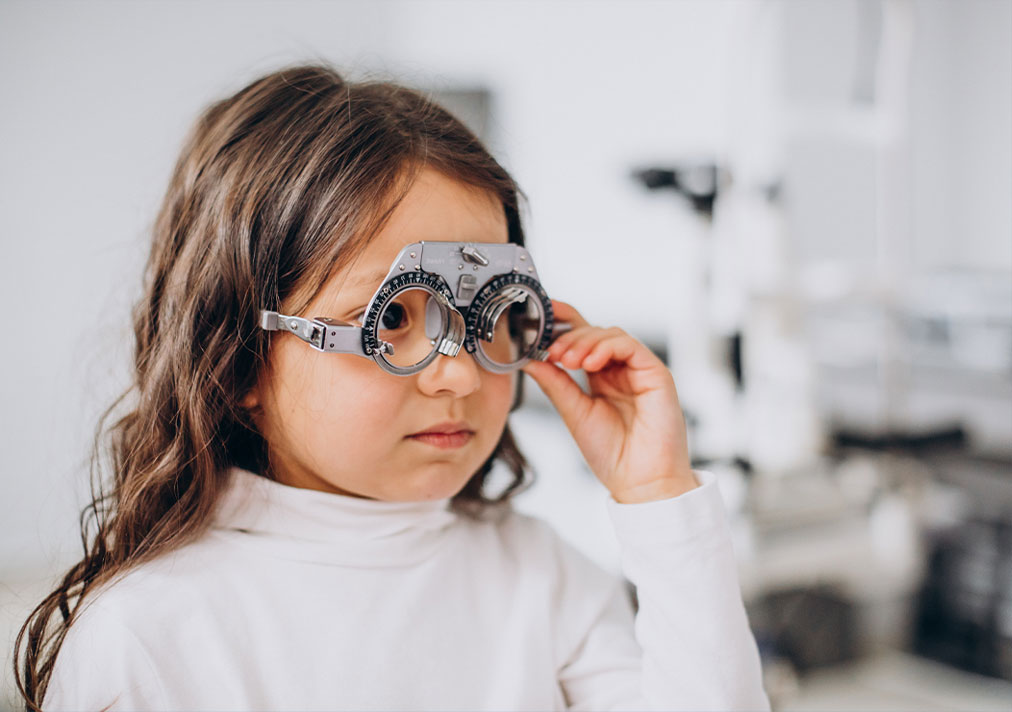
An eye test chart is the poster with rows of letters or symbols that gets smaller line by line the one you read at the eye doctor. It measures how clearly you can see from a distance.
6/6 (or 20/20) vision means your eyesight is normal. Numbers below that (like 6/9, 6/12) mean you may need glasses. There are 5 different types of eye test charts for different ages and conditions.
Key fact: An eye test chart checks only visual clarity it does not detect glaucoma, retinal diseases, or other silent eye conditions. A full eye exam by a specialist is always needed for complete eye health.
What Is an Eye Test Chart?
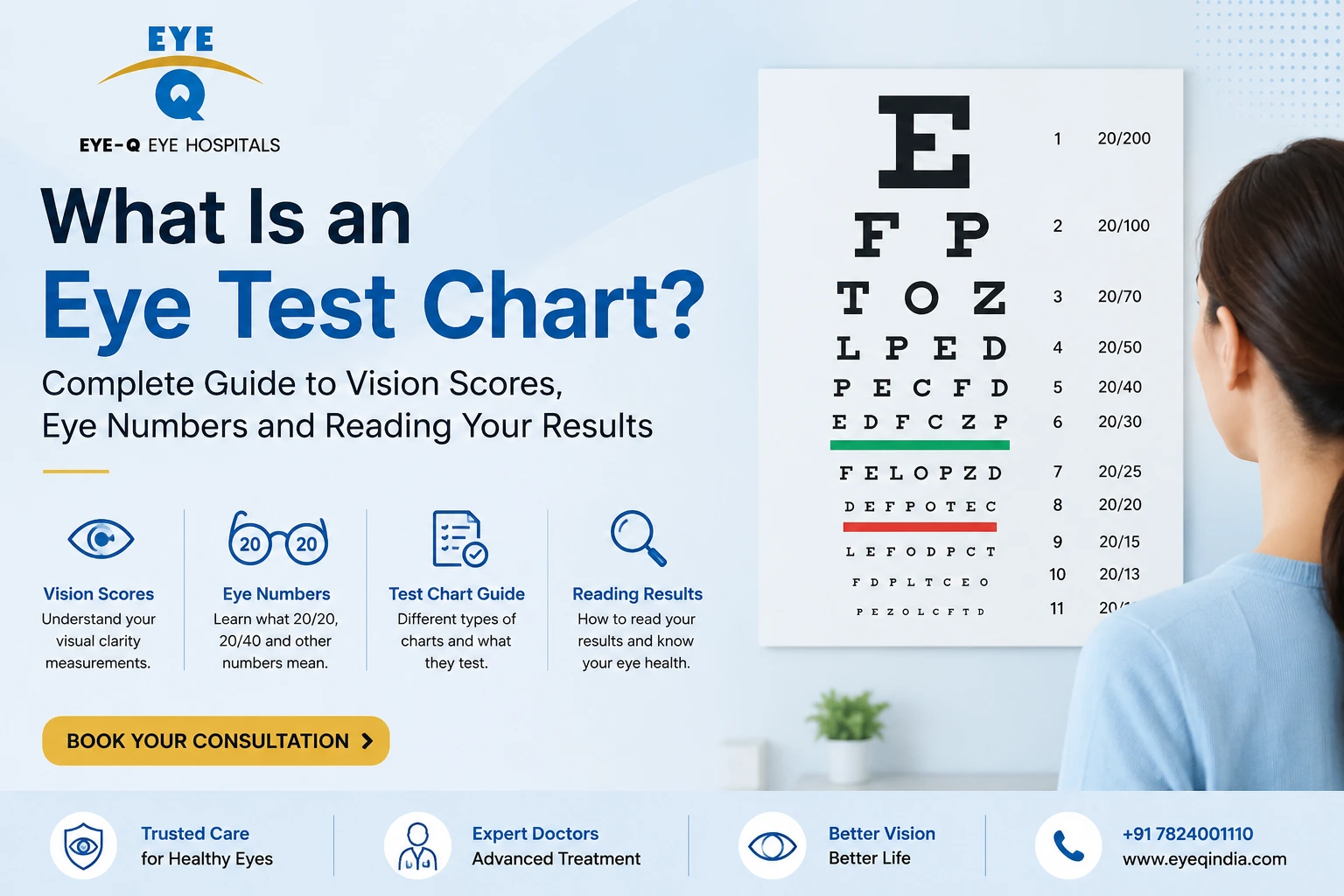
You know that poster on the wall at the eye doctor’s the one with a giant letter E at the top and tiny letters at the bottom? That is an eye test chart, and it is one of the most important tools in all of medicine. It has been measuring human eyesight for over 160 years.
What it actually does: An eye test chart measures your visual acuity which basically means how sharp and clear your vision is. The doctor asks you to read letters (or symbols) from a set distance. The smaller the letters you can read, the sharper your vision.
What it does NOT do: This is really important to understand. An eye test chart only measures how clearly you can see letters at a distance. It does not check your eye pressure, look at your retina, detect glaucoma, or examine the back of the eye. Those need separate tests. Passing an eye chart test does not mean your eyes are fully healthy it just means your distance vision is clear.
Want to check your vision first? Try EyeQ India online eye test. If you notice any vision concerns, book a comprehensive eye examination with an eye specialist.
The Snellen Eye Chart: How It Works
The Snellen chart is the original and most famous eye test chart. It was invented in 1862 by Dutch ophthalmologist Dr. Herman Snellen, and its basic design has barely changed since. The chart has 11 rows of letters in decreasing sizes, starting with one giant letter at the top and ending with tiny letters at the bottom.
Here is how the test works step by step:
- You stand or sit 6 metres (20 feet) away from the chart.
- The doctor covers one eye at a time.
- You read the letters aloud from top to bottom, as far down as you can.
- The doctor records the smallest line you can read correctly.
- This gives your vision score – written as a fraction like 6/6, 6/9, or 6/12.
What the numbers mean: The top number is the distance you stood from the chart (6 metres). The bottom number is the distance a person with normal vision would need to stand to read the same line. So 6/12 means you can only read at 6m what a normal eye can read at 12m.
6/6 vision (called 20/20 in the USA) means your distance vision is normal. It is the target line on the chart. The row just above it is the 6/6 line if you can read it correctly, you have normal visual acuity.
Curious about your eye score? Get a professional vision test at EyeQ India
Vision Score Chart: What Is a Normal Eye Test Reading?
Your vision score tells you how your eyesight compares to normal. Here is a complete guide to what every score means in real life from perfect vision to legal blindness:
| Score (India/UK : US) | Category | What It Means | Real-world Impact | Level |
| 6/6 (20/20) | Normal / Perfect | You can see at 6m what a healthy eye should see at 6m. | No glasses needed. This is the target. | Green |
| 6/9 (20/30) | Slightly below normal | Can see at 6m what a normal eye sees at 9m. | May need glasses for driving or board work. | Yellow-green |
| 6/12 (20/40) | Mild impairment | Can see at 6m what a normal eye sees at 12m. | Glasses recommended. Often needed for driving licence. | Amber |
| 6/18 (20/60) | Moderate impairment | Can see at 6m what a normal eye sees at 18m. | Glasses essential for most daily tasks. | Orange |
| 6/24 (20/80) | Significant impairment | Significant distance vision difficulty. | Strong prescription needed. Work and driving affected. | Red-orange |
| 6/60 (20/200) | Severe impairment | Can only see at 6m what a normal eye sees at 60m. | Very thick glasses or contact lenses needed. | Red |
| Worse than 6/60 | Legal blindness threshold | Cannot read the top letter of the Snellen chart at 6m. | Severe visual impairment — requires professional assessment | Dark red |
In India, vision is usually reported as 6/6 notation (metres). In the USA, the same scores are written as 20/20 notation (feet). They mean exactly the same thing just different measurement units. 6/6 = 20/20 = normal vision.
What is a bad eyesight score? Any score worse than 6/12 (20/40) is generally considered to affect daily activities. In India, 6/12 is the minimum visual standard for an unrestricted driving licence. Scores of 6/60 or worse indicate significant visual impairment.
If your vision score is below 6/9, book an eye exam at EyeQ India to get the right glasses, contacts, or treatment.
How to Read Your Eye Test Results: OD, OS, SPH, CYL & AXIS
So the doctor hands you a slip of paper with strange symbols and numbers. What does it all mean? Do not worry here is a simple breakdown of every symbol on your eye prescription:
| Symbol | Full Name | What It Means | Example |
|---|---|---|---|
| OD | Oculus Dexter | Your right eye. Always written first on a prescription. | OD: -1.50 means right eye has -1.50D myopia. |
| OS | Oculus Sinister | Your left eye. Written after OD. | OS: -2.00 means left eye needs -2.00D correction. |
| SPH (Sphere) | Spherical power | The main lens strength. Negative (-) = myopia. Positive (+) = hyperopia. | SPH -3.00 means moderate nearsightedness. |
| CYL (Cylinder) | Cylindrical power | Corrects astigmatism (blurry vision at all distances due to uneven cornea). | CYL -0.75 means mild astigmatism. |
| AXIS | Axis of astigmatism | The angle (0-180 degrees) at which the CYL correction sits. Only present if CYL is present. | AXIS 90 means the astigmatism correction is at 90 degrees. |
| ADD | Addition power | Extra reading power for presbyopia (age-related near vision loss). Always positive. | ADD +1.50 means bifocal/reading glasses for over-40s. |
| PRISM | Prism correction | Corrects alignment problems between the two eyes (squint or double vision). | Prism 2 Base In – corrects eye misalignment. |
| PD | Pupillary Distance | The distance between your two pupils in millimetres. Needed to cut lenses correctly. | PD 64 means 64mm between pupils – needed for glasses manufacturing. |
Example prescription decoded: OD: -2.50 / -0.75 x 90 means: Right eye has 2.50D of myopia (SPH) and 0.75D of astigmatism (CYL) with the correction angled at 90 degrees (AXIS). In plain English: the right eye is moderately short-sighted with a small amount of blur from astigmatism.
Eye Power Chart: What Do Your Eye Numbers Mean?
In India, your glasses power is called your ‘eye number’. Here is a complete guide to what each range of numbers means for your vision:
| Eye Number | Category | What You Need | What It Feels Like |
|---|---|---|---|
| 0.00 (Plano) | No prescription needed | No glasses needed | Normal vision – no refractive error |
| -0.50 to -3.00 | Low myopia | Glasses recommended | Mild blur at distance – letters on boards, signs |
| -3.00 to -6.00 | Moderate myopia | Glasses needed | Significant distance blur – cannot drive safely without specs |
| -6.00 or higher | High myopia | Strong glasses or contact lenses essential | Very blurry at distance – everything beyond arm’s length unclear |
| +0.50 to +2.00 | Low hyperopia | Glasses for extended near tasks | Near blur – reading, screens. Distance may be fine. |
| +2.00 to +5.00 | Moderate hyperopia | Glasses recommended | Both near and distance affected |
| +5.00 or higher | High hyperopia | Glasses essential | Strong blur at all distances – specialist care needed |
| -0.25 to -1.00 CYL | Mild astigmatism | Usually glasses recommended | Slight blurring or distortion at all distances |
| -1.00 to -3.00 CYL | Moderate astigmatism | Glasses essential | Clear blurring or ghosting of images at all distances |
Is minus 7.5 eyesight bad? Yes – -7.5D is classified as high myopia with an increased risk of retinal detachment, glaucoma, and macular changes. Annual dilated eye exams are essential. LASIK, SMILE, or ICL surgery may be options worth discussing.
Is +2.5 a bad eyesight score? Not necessarily bad +2.5D of hyperopia (farsightedness) is a mild-to-moderate prescription. Most people manage well with glasses or contact lenses.
Not sure what your eye number means for your treatment options? Consult an EyeQ India specialist
6 Types of Eye Test Charts: Which One Is Right for You?
The Snellen chart is not the only eye test chart. Different situations call for different charts. Here is a complete guide to every type:
| Chart Type | How Common | How It Works | Best For | Key Purpose |
| Snellen Chart | Most common | The classic chart with rows of big-to-small letters (E, F, P, T…). Used at 6 metres (20 feet). | Adults and older children who can read letters | Measures distance vision. Bottom row is 6/6 (normal). A must for every basic eye test. |
| Tumbling E Chart | Common | Only the letter E, shown pointing in 4 different directions. The patient points which way the E is facing. | Young children, people who cannot read, language barriers | Perfect for pre-school children. No reading required – just point the direction. |
| Lea Symbols Chart | Common (children) | Uses simple shapes: house, circle, apple, square. Children identify the symbol. | Infants and very young children (age 1-5) | The friendliest eye test for little ones. Identifies vision problems before school. |
| LogMAR Chart | Clinical use | Like Snellen but more scientifically precise. Each row has an equal number of letters and consistent spacing. | Post-surgery patients, clinical research, precise testing | More accurate than Snellen. Used after LASIK, cataract surgery, or for clinical measurements. |
| Jaeger Chart | Near vision | A card with paragraphs of text in decreasing font sizes. Held close to the face (30-35 cm). | Adults over 40, anyone with reading difficulty, presbyopia | Checks near vision specifically. Identifies if you need reading glasses. |
| Ishihara Plates | Colour vision | Circles made of coloured dots. Numbers or shapes are hidden inside – only visible if colour vision is normal. | Children, career screening, pilots, drivers | Identifies colour blindness quickly. Crucial for careers where colour recognition matters. |
For children in India: The Lea Symbols chart and Tumbling E chart are widely used in paediatric eye clinics. If your child has not had an eye test before school, these charts help identify vision problems that could be affecting their learning.
EyeQ India uses age-appropriate charts for all patients. Book a paediatric or adult eye test
What Happens During a Full Eye Exam? Step by Step
An eye test chart is just the beginning. A full comprehensive eye exam at a proper eye clinic includes several steps:
- Vision chart test (Snellen/LogMAR): Reads your distance visual acuity – the starting point of every exam.
- Refraction test: The doctor flips different lenses in front of your eye asking ‘which is clearer – this or this?’ until your perfect prescription is found.
- Near vision test (Jaeger chart): Checks your reading vision at close distance.
- Eye pressure test (tonometry): A puff of air or a gentle probe checks the pressure inside your eye. High pressure can indicate glaucoma.
- Slit lamp examination: A microscope with a bright light examines the front of the eye cornea, iris, lens.
- Dilated fundus examination: Drops widen the pupil so the doctor can examine the retina, optic nerve, and blood vessels at the back of the eye. This is essential for detecting diabetic eye disease, macular degeneration, and glaucoma.
- Colour vision test (if needed): Ishihara plates check for colour blindness.
Total time: A basic test takes 20-30 minutes. A full comprehensive exam takes 45-60 minutes (including dilation time). Always allow extra time if drops are used your vision will be blurry for 2-4 hours after dilation.
EyeQ India offers full comprehensive eye exams at all locations. Book your eye exam today
How Often Should You Get an Eye Test? Recommended Schedule by Age
Regular eye tests protect your vision even when your eyes feel perfectly fine. Many serious conditions have no early symptoms. Here is the recommended schedule:
| Who | How Often | Why It Matters |
| Babies (0-12 months) | 6 months | Checks for misaligned eyes, congenital problems. Early detection is critical. |
| Toddlers (1-3 years) | Around 1.5 years | Checks for lazy eye (amblyopia) and squint – treatable if caught early. |
| Pre-school (3-5 years) | Before school entry | Vision problems affect learning from day one. School board tests miss many issues. |
| School children (6-17) | Every 1-2 years | Myopia progresses fast in this age group. Undetected vision problems affect academic performance. |
| Adults (18-39) | Every 2 years | Monitors for new refractive error development or changes. |
| Adults with glasses/lenses | Every year | Prescriptions change. Outdated glasses cause headaches and eye strain. |
| Adults 40+ | Every year | Presbyopia starts around 40. Glaucoma and cataract risk begins increasing. |
| Adults 60+ | Every 6-12 months | High risk of cataract, glaucoma, macular degeneration, and diabetic eye disease. |
| Diabetics (any age) | Every year (minimum) | Diabetic retinopathy has no early symptoms – annual dilated exam is essential to prevent blindness. |
| Family history of eye disease | Every year | Glaucoma, macular degeneration, and keratoconus can be hereditary. |
For Indian children specifically: Research shows that 1 in 5 school children in India has an undetected vision problem. Many children with poor grades are actually struggling to see the board not struggling to learn. A 15-minute eye test can change a child’s school life entirely.
Schedule a school-age eye test for your child at EyeQ India – early detection prevents permanent vision problems.
Myths vs Facts About Eye Test Charts
There are many common misunderstandings about eye tests. Here is the truth:
| MYTH | FACT |
| If I can see clearly, I do not need an eye test. | Many serious conditions (glaucoma, retinal disease, diabetic eye disease) have NO early symptoms. You can be losing vision silently. An eye test saves sight, not just fixes blur. |
| Online eye test charts are as good as a real exam. | Online charts check only basic letter recognition. They cannot measure eye pressure, scan the retina, detect glaucoma, or determine your exact prescription. They are a screening toy, not a medical test. |
| Children do not need eye tests if they are not complaining. | Children often cannot tell they have poor vision because they have never experienced anything different. Many assume everyone sees the world as they do. Regular tests catch amblyopia, squint, and myopia before they cause permanent problems. |
| Wearing glasses makes your eyes weaker. | Glasses correct vision they do not change the eye itself. Your prescription may increase over time due to natural eye growth or age, but wearing glasses does not cause or speed this up. |
| 6/6 vision means my eyes are completely healthy. | 6/6 means your visual acuity (sharpness) is normal at distance. It says nothing about eye pressure, retinal health, corneal condition, or early glaucoma. A full exam is always needed for complete eye health. |
| Eye tests are only for people who struggle to see. | Eye tests detect conditions like glaucoma, macular degeneration, and diabetic retinopathy all of which are silent in early stages. Regular testing is health maintenance, not just vision correction. |
Key Takeaways
- An eye test chart measures visual acuity only – how sharply you see letters at distance. It is not a full eye health check.
- 6/6 (or 20/20) is normal vision. Scores worse than 6/12 affect daily activities and usually need glasses.
- There are 6 types of eye charts – Snellen, Tumbling E, Lea Symbols, LogMAR, Jaeger, and Ishihara – each for different ages and conditions.
- Your prescription numbers (SPH, CYL, AXIS, ADD) describe your exact lens requirements. Negative = myopia. Positive = hyperopia.
- Every eye test includes much more than the chart – refraction, pressure, slit lamp, and ideally a dilated retinal exam.
- Children should be tested before school entry – undetected vision problems are a leading hidden cause of learning difficulties.
- Diabetics and over-60s should have dilated eye exams every year – silent diseases like diabetic retinopathy and glaucoma can be caught early only this way.
Start with EyeQ India free online eye test to get a quick indication of your visual acuity, advanced diagnostics, 30+ locations across India.
Medical Disclaimer
This article is for informational purposes only. It does not replace professional medical advice. Always consult a qualified ophthalmologist for eye health concerns.
Frequently Asked Questions
What is a normal eye test reading?
A normal eye test reading is 6/6 (written as 20/20 in the USA). This means you can see clearly at 6 metres what a healthy eye should see at 6 metres. Any score of 6/6 or better is normal. Scores worse than 6/9 may mean you benefit from glasses.
What is a bad eyesight score?
A score worse than 6/12 (20/40) is generally considered to affect daily tasks like driving or reading a board. A score of 6/60 or worse indicates significant visual impairment. Any score below 6/6 that affects your daily life is worth discussing with an eye specialist.
How do I read my eye test results?
Your prescription has numbers for SPH (sphere = main power), CYL (cylinder = astigmatism), and AXIS (angle of astigmatism). Negative SPH means myopia (shortsightedness). Positive SPH means hyperopia (farsightedness). OD = right eye, OS = left eye. Your eye doctor can explain what each number means for you.
What does 20/20 or 6/6 vision mean?
20/20 (USA) and 6/6 (India/UK) mean exactly the same thing – normal visual acuity. The numbers represent the testing distance. 6/6 means you can see at 6 metres what a healthy eye should see at 6 metres. It is the target line on the standard Snellen eye chart.
What is a good eye test score?
6/6 (20/20) is the standard for normal vision. Some people can achieve 6/5 or 6/4 – better than average. For driving in India, a minimum of 6/12 in the better eye is required. For most career requirements, 6/6 with or without correction is the standard.
What does 20/30 vision mean?
20/30 vision (6/9 in the Indian/metric system) means you can see at 20 feet what a person with normal vision sees at 30 feet. It is mildly below normal but may not require glasses unless it affects daily life. Your eye doctor will advise based on symptoms and lifestyle.
Can I check my eyesight at home?
You can use a printed or online Snellen chart for a rough idea of your visual acuity. Stand 6 metres away and read the smallest line you can. However, home tests cannot measure your prescription accurately, check eye pressure, or detect retinal or nerve problems. A professional eye exam is always needed for reliable results.
What does 6/6 vision mean in the Snellen eye chart?
The 6/6 line is the second row from the bottom of a standard Snellen chart. If you can read it correctly at 6 metres, your distance visual acuity is considered normal. The bottom row (6/5 or 6/4) is better than average – some people with very sharp vision can read even smaller letters.