


QUICK ANSWER
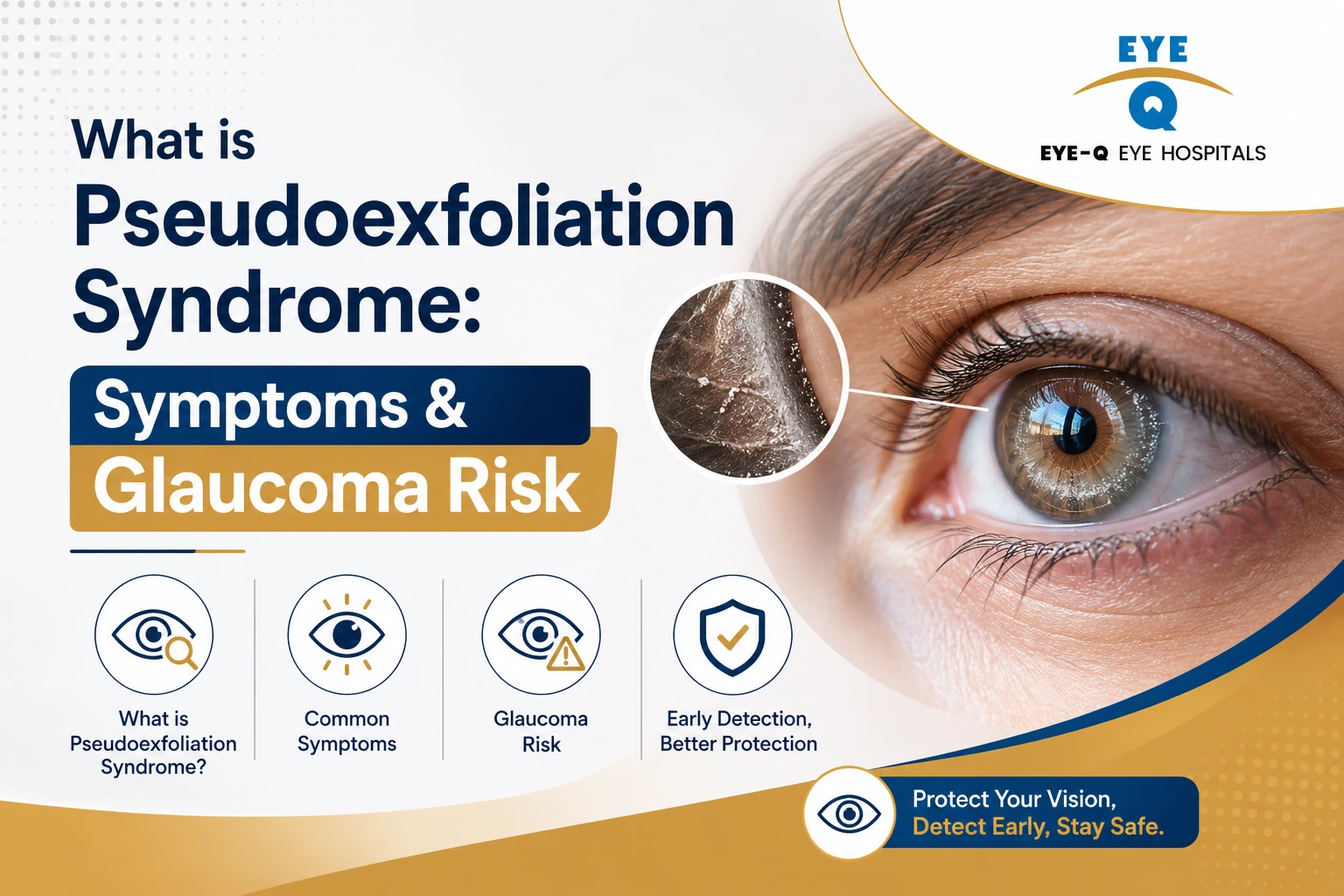
Pseudoexfoliation syndrome (PXF) is a condition where tiny flakes of protein build up inside the eye, like dandruff for your eye. These flakes can block the eye’s drainage system, raise pressure inside the eye, and lead to glaucoma and vision loss.
Key facts: Most common in people over 60. Usually has no early symptoms. About 40-50% of people with PXF eventually develop glaucoma. There is no cure, but the condition can be managed with eye drops, laser treatment, or surgery. Regular eye exams are essential.
What Is Pseudoexfoliation Syndrome?
Think of it like dandruff, but inside your eye. Pseudoexfoliation syndrome (also written as PXF or PXE) is a condition where the body produces tiny flakes of protein material – almost like microscopic white-grey dust – that slowly build up on the surfaces inside the eye.
These flakes form on parts like the lens, the iris (the coloured ring of your eye), and the tiny drainage canal that lets fluid leave the eye. Normally, fluid flows in and out of the eye in a balanced way, keeping the pressure inside your eye at a healthy level. But when these flakes build up and block that drainage canal, the pressure inside the eye starts to rise – and that rising pressure can quietly damage the optic nerve.
The optic nerve is your eye’s cable to the brain. It carries all the pictures your eye sees and sends them to your brain. When this nerve gets damaged, you start losing your vision – and that loss is permanent.
Want to understand more about how your eye works? Read our guide at EyeQ India – General Eye Care
How Common Is Pseudoexfoliation Syndrome?
Pseudoexfoliation syndrome is actually the most common cause of secondary glaucoma in the world. Around 70 million people are estimated to have it globally. In India, it is quite prevalent, especially in people above 60 years of age.
- It is more common in people over 60. It is very rare in anyone under 50.
- It can affect one eye or both. When only one eye is affected, the other eye may develop it later.
- 40 to 50% of people with PXF will eventually develop glaucoma if they do not receive proper monitoring and treatment.
- It is slightly more common in women than in men.
If you are over 60 or have a family history of glaucoma, get a comprehensive eye check at EyeQ India – early detection changes outcomes.
What Causes Pseudoexfoliation Syndrome?
Doctors do not know exactly why some people produce these protein flakes and others do not. But over many years of research, we now know which things make you more likely to develop PXF:
| Risk Factor | What It Means | Important Detail |
| Age | People over 60 are most commonly affected. It is very rare in people under 50. | Age is the biggest risk factor. The older you are, the higher the chance. |
| Family history | If your parent or sibling has PXF, your own risk goes up. | A genetic link has been confirmed. One key gene involved is LOXL1. |
| Race | More common in people of Northern European (Scandinavian) descent. | Also seen in Indian, Australian, and Middle Eastern populations. |
| Gender | Slightly more common in women than men. | Reason is not fully understood yet. |
| Sun exposure (UV) | Too much sunlight over many years increases risk. | People who work outdoors long-term are more exposed. |
| Low folate (Vitamin B9) | Not getting enough folate in the diet has been linked to PXF. | Green leafy vegetables, lentils, and legumes are good sources. |
| Excessive coffee | Drinking more than 3 cups of caffeinated coffee per day may increase risk. | Decaffeinated coffee does not carry the same risk. |
| Cold or northern climates | More PXF cases are found in colder countries like Iceland, Norway, Sweden. | May be linked to reduced UV exposure or other environmental factors. |
Bottom line: You cannot always prevent PXF, because age and genetics play the biggest roles. But knowing your risk means you can get checked more often and catch any problems early – before they damage your vision.
What Are the Signs and Symptoms of Pseudoexfoliation Syndrome?
Here is something that surprises most people: pseudoexfoliation syndrome usually has NO symptoms at all in the early stages. You cannot feel the flakes. You cannot see them. You do not get pain. Nothing hurts.
This is exactly what makes it dangerous. By the time vision problems appear, significant damage may already have been done to the optic nerve. The only way to find PXF early is through a proper eye examination by a doctor.
What a doctor looks for during the exam:
- White flake deposits: Visible on the front surface of the lens when examined under a slit lamp – a special microscope doctors use to look inside your eye.
- Pigment deposits: Brownish pigment grains found in the drainage area of the eye.
- Raised intraocular pressure (IOP): Eye pressure above the normal range (usually above 21 mmHg).
- Optic nerve changes: Signs of damage or cupping in the optic nerve head.
- Visual field loss: Blind spots or narrowing of peripheral (side) vision – seen in later stages.
When symptoms do eventually appear, they look like glaucoma symptoms: gradual loss of side vision, blurred vision, seeing halos around lights, and in severe cases, significant loss of central vision.
If you notice any change in your vision, see an eye specialist at EyeQ India immediately – do not wait.
What Is the Difference Between Pseudoexfoliation Syndrome and Pseudoexfoliative Glaucoma?
This is one of the most searched questions about this condition. Here is the clear difference:
| Feature | Pseudoexfoliation Syndrome (PXF) | Pseudoexfoliative Glaucoma (PXG) |
| What it is | A protein buildup condition affecting the eye | A type of glaucoma caused by PXF |
| Main problem | Flakes clog the eye’s drainage system | High eye pressure damages the optic nerve |
| Symptoms | Usually none in early stages | Usually none until late stage; then vision loss |
| Reversible? | The protein buildup cannot be removed | Vision loss from glaucoma cannot be reversed |
| Treatment goal | Monitor closely; prevent glaucoma | Lower eye pressure to stop further nerve damage |
| How common | About 70 million people worldwide have PXF | 40-50% of PXF patients develop PXG over time |
Think of it this way: Pseudoexfoliation syndrome is the problem. Pseudoexfoliative glaucoma is what happens if that problem is not caught and managed in time. You can have PXF without ever developing glaucoma – but only if you get regular check-ups.
Learn more about glaucoma at EyeQ India – Glaucoma Treatment
How Does Pseudoexfoliation Syndrome Affect Your Eyes?
The flakes themselves do not directly hurt your eye. It is the knock-on effects that cause damage. Here is what PXF can do:
| Complication | How Common | What Happens | Why It Matters |
| Glaucoma | 40-50% of PXF patients | The flakes block the drainage canal (trabecular meshwork), raising eye pressure. High pressure damages the optic nerve. Vision loss can become permanent. | Annual eye exams to monitor eye pressure and optic nerve health. |
| Cataracts | Common | PXF weakens the tiny fibers (zonules) that hold the eye’s lens in place. This makes the lens cloudy faster. | Cataract surgery is more complex with PXF. Specialist surgeons are needed. |
| Pseudoexfoliative Glaucoma (PXG) | Subset of glaucoma | The most specific complication. PXG progresses faster than regular glaucoma, with higher pressure spikes and more optic nerve damage. | Needs earlier, more aggressive treatment than regular glaucoma. |
| Surgical complications | During cataract surgery | Weak zonules can cause the lens to shift during surgery, increasing risk. | Surgeons must use special techniques and lens types. |
The good news: Every one of these complications can be managed if PXF is detected early enough through regular eye exams. The earlier the problem is found, the better the outcome.
How Is Pseudoexfoliation Syndrome Diagnosed?
Diagnosis is done during a comprehensive eye examination. Your eye doctor will use several tools and tests:
- Slit lamp examination: A powerful microscope shines light into your eye so the doctor can see the flakes on the lens surface and pupil margin. This is the key test for diagnosing PXF.
- Tonometry (eye pressure test): Measures the pressure inside your eye. High pressure is a sign that the drainage system may be blocked by flakes.
- Gonioscopy: A special lens is placed on the eye to examine the drainage angle directly and look for pigment deposits and flake material.
- Optical Coherence Tomography (OCT): A detailed scan of the optic nerve to check for early damage before you lose any vision.
- Visual field test (perimetry): Checks whether you have lost any peripheral vision, which is one of the first things glaucoma affects.
No blood test or genetic test is used in routine diagnosis. It is entirely based on the eye examination findings.
Get a full glaucoma screening and PXF check at EyeQ India – available across Gujarat, Haryana, UP and Uttarakhand.
How Is Pseudoexfoliation Syndrome Treated?
PXF itself cannot be cured or reversed. The flakes cannot be washed out of the eye. What doctors can do is treat the complications – mainly glaucoma – before they permanently damage your vision.
The goal of treatment is simple: keep the eye pressure under control to protect the optic nerve. Here is how that is done:
| Treatment | When Used | How It Works | Key Note |
| Medicated Eye Drops | First choice treatment | Drops that reduce how much fluid the eye makes, or help fluid drain better. Common types: prostaglandin analogues (e.g. latanoprost), beta-blockers (e.g. timolol), alpha-agonists (e.g. brimonidine). | Used once or twice daily. PXF glaucoma often needs stronger or combination drops vs. regular glaucoma. |
| Laser Trabeculoplasty (SLT/ALT) | When drops are not enough | A laser is used to open up the blocked drainage channel inside the eye, helping fluid escape and pressure drop. | Works well in PXF because the drainage blockage responds to laser. Results can last 1-5 years. |
| Minimally Invasive Glaucoma Surgery (MIGS) | Moderate cases | Tiny devices or channels are placed inside the eye to improve drainage without major surgery. | Less recovery time than traditional surgery. Suitable for early-to-moderate PXF glaucoma. |
| Trabeculectomy (Filtering Surgery) | When other treatments fail | A small new drainage opening is created in the eye wall to let fluid escape. | The most effective surgery for lowering eye pressure. Used in advanced cases. |
| Glaucoma Drainage Implants | Severe or complex cases | A tiny tube is placed in the eye to drain fluid to a small reservoir under the eyelid. | Used when trabeculectomy is not suitable or has not worked. |
| Cataract Surgery (if needed) | When cataracts develop | Cloudy lens is removed and replaced with an artificial lens. In PXF, surgeons use special techniques because of weak zonular fibers. | Requires an experienced surgeon. May also help reduce eye pressure in some cases. |
Important: PXF glaucoma often needs earlier and more aggressive treatment than regular glaucoma, because the pressure spikes are larger and less predictable. Do not skip follow-up appointments.
EyeQ India offers the full range of glaucoma treatments. Book a consultation with an EyeQ Glaucoma Specialist
Pseudoexfoliation Syndrome and Cataract Surgery: What You Need to Know
This is a section most websites skip – but it is very important for patients with PXF. PXF makes cataract surgery riskier and more technically demanding.
Here is why: the flakes of protein weaken the tiny fibers called zonules that hold the lens in position. In a healthy eye, these fibers are strong and steady. In a PXF eye, they are fragile – like a safety net with some threads missing. This increases the chance of complications during cataract surgery.
Specific risks during cataract surgery with PXF:
- Lens dislocation: The weakened zonules may not hold the lens steady during surgery.
- Posterior capsule rupture: The thin bag holding the lens can tear if the surgeon pulls too hard trying to manage zonular weakness.
- Vitreous loss: Gel from the back of the eye may leak into the surgical area.
- Intraocular lens (IOL) displacement: The artificial lens placed after cataract removal may shift if the support structure is weak.
What to do if you need cataract surgery: Always tell your eye surgeon that you have PXF. An experienced surgeon will use special techniques – such as capsular tension rings and slower, gentler phacoemulsification – to reduce these risks. The surgery is very manageable with the right precautions.
EyeQ India’s cataract specialists are trained to handle complex cases including PXF. Learn about Cataract Surgery at EyeQ India
How Often Should You Get Eye Exams If You Have PXF?
This depends on your current situation. Use this table as a guide:
| Your Situation | How Often to Visit | Why |
| No PXF, no risk factors | Once every 2 years | Standard adult eye exam. |
| PXF diagnosed, no glaucoma | Every 6-12 months | Track eye pressure, optic nerve, and visual fields closely. |
| PXF with high eye pressure | Every 3-6 months | More frequent checks to catch glaucoma early before nerve damage. |
| PXF glaucoma (treated) | Every 3-6 months | Check that treatment is working and pressure is under control. |
| PXF glaucoma (advanced) | Every 1-3 months | Very close monitoring to prevent further vision loss. |
Never miss a follow-up appointment. PXF glaucoma can progress silently. The only way to know if your treatment is working is regular monitoring by your eye doctor.
Schedule your next eye exam at EyeQ India – easy booking across 30+ locations.
What Can You Do at Home to Help?
You cannot remove the flakes or undo the condition. But there are simple, evidence-backed things you can do every day that genuinely help:
- Take your eye drops exactly as prescribed – every day. Even on good days. Even on days when your eyes feel fine. PXF glaucoma pressure can spike unpredictably, and your drops are your main protection.
- Eat leafy greens and lentils. Low folate (Vitamin B9) has been linked to PXF. Spinach, kale, dal, and chickpeas are great, cheap sources.
- Wear UV-blocking sunglasses outdoors. Excess sun exposure is a confirmed risk factor for PXF. Good sunglasses protect your eyes every single day.
- Reduce excessive coffee. If you drink more than 3 cups of caffeinated coffee a day, consider cutting back. Switch to decaf or herbal tea for a few cups.
- Never rub your eyes roughly. This can dislodge flake material and cause pressure spikes in susceptible eyes.
- Tell your family. PXF has a genetic link. If you have been diagnosed, encourage your siblings and adult children to get checked too.
Worried about pseudoexfoliation syndrome or glaucoma? Book a comprehensive eye exam at EyeQ India – glaucoma specialists, advanced diagnostics, 30+ locations across India.
Frequently Asked Questions
What is pseudoexfoliation syndrome?
Pseudoexfoliation syndrome (PXF) is a condition where the body produces tiny flakes of protein that build up inside the eye, blocking its drainage system. This raises eye pressure and can lead to glaucoma and vision loss. It is most common in people over 60 and often has no early symptoms.
What is the difference between pseudoexfoliation syndrome and pseudoexfoliative glaucoma?
Pseudoexfoliation syndrome (PXF) is the buildup of protein flakes in the eye. Pseudoexfoliative glaucoma (PXG) is what happens when those flakes block the eye’s drainage and raise the pressure enough to damage the optic nerve. You can have PXF without glaucoma – but 40-50% of PXF patients eventually develop it.
What are the symptoms of pseudoexfoliation syndrome?
In the early stages, there are usually no symptoms at all – no pain, no blurring, nothing you would notice. That is why regular eye exams are so important. In later stages, symptoms look like glaucoma: gradual loss of side vision, blurred vision, and eventually central vision loss.
How is pseudoexfoliation syndrome treated?
PXF itself has no cure, but its main complication – glaucoma – can be managed. Treatments include eye drops to lower eye pressure, laser trabeculoplasty to open the drainage canal, and surgery (trabeculectomy or implants) in more advanced cases. The goal is to protect the optic nerve from further damage.
Can pseudoexfoliation syndrome lead to blindness?
Yes, it can – but only if the resulting glaucoma is left undetected or untreated for a long time. With regular eye exams and proper treatment, most people with PXF protect their vision and do not go blind. The key is catching it early and sticking to treatment.
What are the signs of glaucoma in pseudoexfoliation syndrome?
Glaucoma caused by PXF often has no early warning signs. As it progresses, you may notice blind spots at the edges of your vision, blurred vision, or halos around lights. By the time these are noticeable, significant damage may have already occurred – which is why annual eye exams are vital.
Is pseudoexfoliation syndrome hereditary?
Yes, there is a genetic component. The LOXL1 gene mutation is strongly linked to PXF. If a parent or sibling has PXF, your risk is higher. However, not everyone with the gene mutation develops the condition, so other factors like age and environment also play a role.
Is pseudoexfoliation syndrome the same as exfoliation syndrome?
Yes. The terms are used interchangeably in different countries. Pseudoexfoliation syndrome, exfoliation syndrome, PXF, PXE, and PES all refer to the same condition: the buildup of flaky protein material inside the eye.
Medical Disclaimer
This article is for informational purposes only and does not constitute medical advice. LASIK suitability must be assessed by a qualified ophthalmologist through a proper pre-operative evaluation. Always consult a licensed eye specialist before making any surgical decision.