


QUICK ANSWER
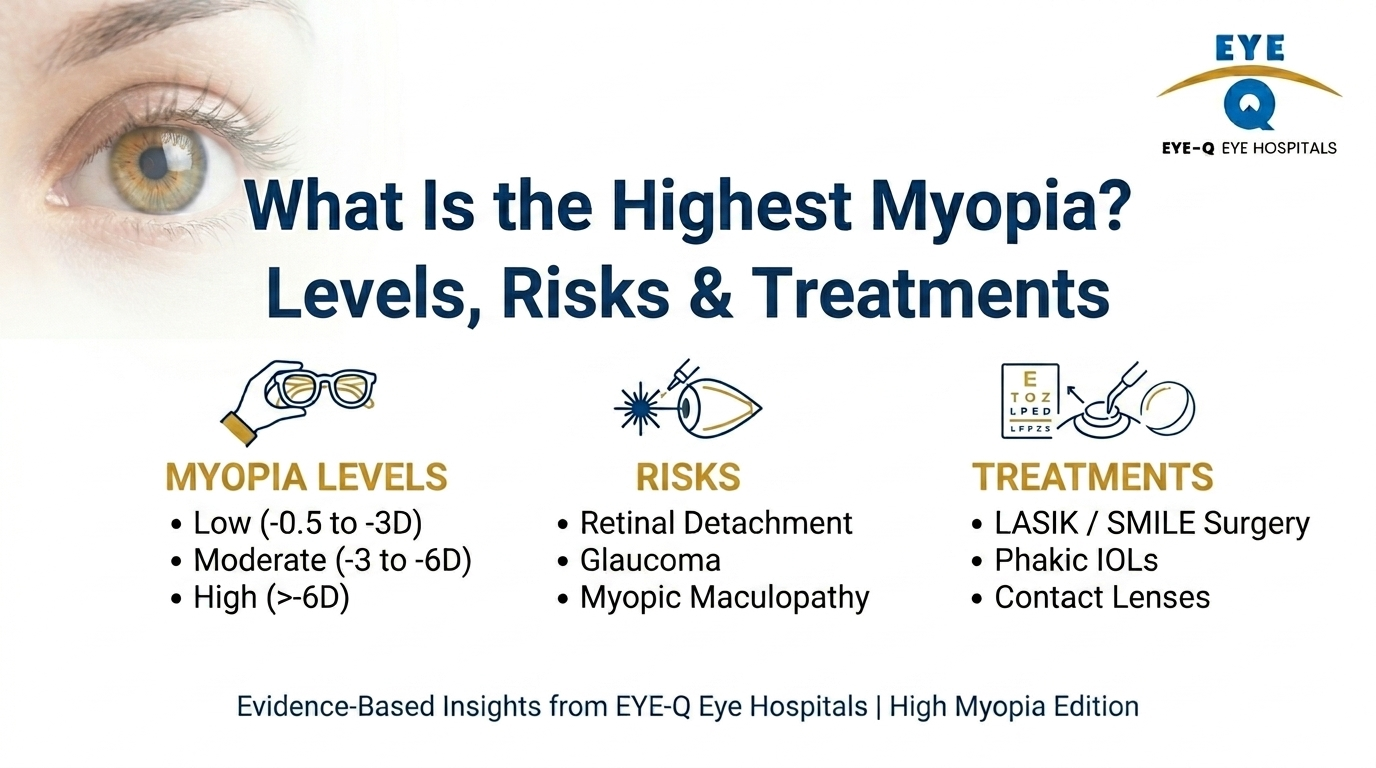
High myopia is defined as a prescription of -6.00 diopters or stronger. The highest myopia ever recorded in medical literature is approximately -108 diopters – an extreme medical rarity. Most people with high myopia fall between -6.00 D and -20.00 D. Pathological myopia (structural eye damage from myopia) affects fewer than 3% of the general population but is a leading cause of irreversible blindness worldwide.
No natural method can reverse myopia. Progression can be slowed with atropine drops, Ortho-K, or DIMS/H.A.L.T. lenses. Permanent correction requires LASIK, SMILE, or ICL surgery.
What Is Myopia?
Myopia (nearsightedness) occurs when the eyeball grows too long from front to back, causing light to focus in front of the retina instead of on it. Close objects appear clear; distant ones look blurry.
Main causes: genetic predisposition (highest risk factor), excessive near work, limited outdoor time, and structural differences in the cornea or lens.
When does it stabilise? In about half of people, myopia plateaus around age 15. Most others stabilise by the mid-20s. High myopia (above -6.00 D) can continue worsening into adulthood.
Also Read : Nearsightedness (Myopia): Symptoms, Causes, Treatment
How Is Myopia Measured?
Myopia is measured in diopters (D) – always as a negative number on your prescription. The larger the number, the stronger the myopia.
- -1.00 D: Clear vision up to about 1 metre without glasses.
- -5.00 D: Clear vision only within 20 cm.
- -10.00 D: Clear vision within 10 cm or less.
- -20.00 D: Very high. Practically no functional distance vision without correction.
Myopia Classification: From Mild to Pathological
The table below shows how myopia is officially classified by the WHO and AAO:
| Category | Prescription | What It Means |
|---|---|---|
| Low Myopia | -0.50 to -3.00 D | Mild blur at distance. Glasses usually sufficient. |
| Moderate Myopia | -3.00 to -6.00 D | Noticeable distance blur. Higher glasses dependency. |
| High Myopia | -6.00 to -10.00 D | Significant impairment. Complication risk begins. |
| Very High Myopia | -10.00 to -20.00 D | Severe vision loss without correction. Surgical options considered. |
| Pathological Myopia | Above -6.00 D with structural damage | Irreversible eye changes. Risk of legal blindness. |
Note: Some clinicians use -8.00 D as the high myopia cutoff. WHO uses -6.00 D as the standard threshold.
What Is the Highest Myopia Ever Recorded?
The highest myopia documented in medical literature is approximately -108 diopters. This is an extreme rarity. At -108 D, clear vision would extend less than 1 cm from the eye without correction.
Why so extreme? Prescriptions this high are almost always linked to underlying genetic or connective tissue disorders (such as Marfan syndrome) that cause severe, lifelong axial elongation of the eyeball.
In everyday clinical practice, most ophthalmologists rarely see prescriptions above -20.00 D to -25.00 D. Standard glasses become impractical beyond -20.00 D due to extreme lens thickness.
| Prescription | Real-world Context |
|---|---|
| -1.00 D | Mild blur at distance. Most people manage without glasses much of the day. |
| -6.00 D | High myopia threshold. Glasses needed for virtually all distance tasks. |
| -10.00 D | Very high. Significant complication risk. Specialist monitoring required. |
| -20.00 D | Upper limit of standard spectacle correction in most optical labs. |
| -108 D | Highest ever recorded. Extreme outlier linked to rare genetic conditions. |
What Is Pathological Myopia?
Pathological myopia is not just a high prescription – it is structural damage to the eye. It is defined as -6.00 D or more (or axial length above 26.5 mm) with degenerative changes to the retina, sclera, or choroid. It affects fewer than 3% of the general population but is among the top 5 causes of irreversible blindness worldwide.
As the eyeball elongates beyond its normal 22-25 mm, the internal layers are stretched and damaged:
- Lacquer cracks: breaks in the retina’s support membrane, triggering abnormal blood vessel growth
- Posterior staphyloma: outward bulging of the back of the eye wall
- Macular atrophy: thinning of the central retina, causing permanent central vision loss
- Vitreous degeneration: the gel inside the eye liquefies, increasing floaters and retinal traction risk
Key point: Glasses and contact lenses correct the refractive error but cannot treat structural damage. Pathological myopia requires specialist retinal care.
Also Read : Ensuring Healthy Vision in Children: Understanding and Preventing Myopia
Risks and Complications of High Myopia
People with -6.00 D have 6-8x the retinal detachment risk of non-myopes. At -10.00 D, this rises to 44x. High myopia also significantly increases the risk of:
| Complication | Risk Level | Details |
|---|---|---|
| Retinal Detachment | Very High | 6–8x more likely at -6D; 44x at -10D and above. |
| Myopic Maculopathy | High | Damage to the central retina. Can cause permanent central vision loss. |
| Glaucoma | High | Raised eye pressure damages the optic nerve. More likely in myopic eyes. |
| Cataracts | Moderate | Develop earlier and more frequently in highly myopic eyes. |
| Choroidal Neovascularisation | High | Abnormal blood vessel growth beneath the retina. Requires anti-VEGF treatment. |
| Posterior Staphyloma | High | Bulging of the back of the eye wall. Indicates severe axial elongation. |
Warning signs requiring immediate medical attention: sudden new floaters, flashes of light, or a dark curtain across your vision. Go to an eye emergency department immediately.
How Is High Myopia Diagnosed and Monitored?
A standard vision test is not enough for high myopia. These are the key clinical tools:
- Dilated fundus exam: checks the retina, macula, and optic nerve for early pathological changes. Needed at least annually for anyone with -6.00 D or above.
- OCT (Optical Coherence Tomography): cross-sectional retinal imaging that detects macular thinning and staphyloma before symptoms appear.
- Axial length measurement: measures the physical length of the eyeball (normal: 22-25 mm; high myopia: above 26.5 mm). Used to track progression and guide treatment.
- Visual field test: checks for peripheral vision loss linked to glaucoma – a common complication of high myopia.
Also Read : Myopia and Hypermetropia: Similarities and Differences
What Is the Maximum Myopia Power in Glasses?
Standard lenses are made up to -20.00 D. Beyond that, lens thickness makes everyday glasses impractical.
- Up to -6.00 D: Standard lenses in most materials.
- -6.00 to -12.00 D: High-index lenses (1.67-1.74) for thinner, lighter profile.
- -12.00 to -20.00 D: Ultra-high-index (1.74-1.76) glass required.
Above -20.00 D: RGP contact lenses or surgery (ICL or RLE) become the practical options.
Can Myopia Power Be Reduced?
No – existing myopia cannot be naturally reversed. The axial elongation of the eyeball is permanent. The goal is to slow progression (in children) or surgically correct the refractive error (in adults).
- Slowing progression: atropine drops, Ortho-K, DIMS or H.A.L.T. spectacles, or MiSight lenses – effective when started early.
- Correcting the refractive error: LASIK, SMILE, or ICL surgery – permanent correction, but does not treat underlying structural damage.
- Extreme myopia (above -20 D): Refractive Lens Exchange (RLE) replaces the natural lens with an artificial IOL – the most practical permanent option.
Read More : How to Cure Myopia Naturally and Effectively: Myth vs Medical Facts
Best Myopia Control Methods: Evidence Comparison
| Treatment | Age Group | Efficacy | Notes |
|---|---|---|---|
| Low-dose Atropine (0.01–0.05%) | 6–14 years | 50–60% | Eye drops nightly. Most evidence-backed pharmacological option. |
| Orthokeratology (Ortho-K) | 6+ years | 40–56% | Overnight rigid lenses reshape the cornea. Provides daytime clear vision. |
| DIMS Lenses (Miyosmart) | 6–14 years | 52% | Everyday spectacles with built-in defocus segments. RCT-proven. |
| H.A.L.T. Lenses (Stellest) | 6–14 years | 67% | Aspherical lenslet spectacles. Highest efficacy spectacle option in trials. |
| MiSight Contact Lenses | 8–12 years | 59% | Daily disposable soft lenses approved for myopia control. |
| LASIK / SMILE Surgery | 18+ years | Corrective | Permanently reshapes the cornea. Does not slow progression. |
| ICL Surgery | 18+ years | Corrective | Lens implanted inside the eye. Suitable for high myopia cases. |
| Refractive Lens Exchange (RLE) | 40+ or extreme | Corrective | Natural lens replaced with IOL. Best for very high prescriptions. |
Combining methods works better: atropine alongside DIMS or Ortho-K produces greater slowing than either alone. Ask a myopia control specialist for a personalized plan.
Key Takeaways
- Highest recorded myopia: -108 diopters – an extreme rarity.
- High myopia threshold: -6.00 D or stronger, affecting about 10% of people globally.
- Pathological myopia: structural eye damage; occurs in fewer than 3% of the general population.
- Cannot be reversed naturally: only slowed (in children) or corrected surgically (in adults).
- Annual eye exams: mandatory for anyone with -6.00 D or above.
Read More : Find an AAO-certified ophthalmologist near you
Frequently Asked Questions
What is the highest myopia ever recorded?
The highest documented myopia is approximately -108 diopters – an extreme rarity linked to rare genetic conditions. Most people with high myopia fall between -6.00 D and -20.00 D. Standard glasses are not practical beyond -20.00 D.
What is the highest level of myopia?
The clinical categories are high myopia (-6.00 to -10.00 D), very high myopia (-10.00 to -20.00 D), and pathological myopia (above -6.00 D with structural eye damage). There is no fixed upper limit – extreme cases can exceed -50.00 D.
Is minus 7.5 eyesight bad?
-7.5 diopters is classified as high myopia. It is fully correctable with glasses or lenses, but carries an increased risk of retinal detachment, glaucoma, and macular changes. Annual dilated eye exams are essential.
Is minus 14 eyesight bad?
Yes – -14.00 D is very high myopia with significant complication risk. Surgical options including LASIK (if corneas are suitable) or ICL should be discussed. Annual specialist monitoring is non-negotiable.
Who has the worst myopia?
The highest published case in ophthalmological literature is approximately -108 diopters. Patient identity is not disclosed in medical records. Extreme cases above -30.00 D are almost always linked to systemic connective tissue disorders.
What is the maximum myopia power in glasses?
Standard spectacle lenses are practical up to -20.00 D using 1.74-1.76 high-index materials. Above -20.00 D, RGP contact lenses or ICL/RLE surgery are the practical alternatives.
Is high myopia a disability?
High myopia can qualify as a visual impairment if it is not fully correctable or causes structural complications such as pathological myopia. Anyone with severely reduced best-corrected vision should be assessed by a low-vision specialist.
Can myopia affect only one eye?
Yes – when the two eyes have significantly different prescriptions (called anisometropia), one eye may be far more myopic. Contact lenses or surgery are usually preferred over spectacles in these cases to avoid image size imbalance.
Medical Disclaimer
This article is for informational purposes only and does not constitute medical advice. Always consult a licensed ophthalmologist or optometrist for diagnosis and treatment.